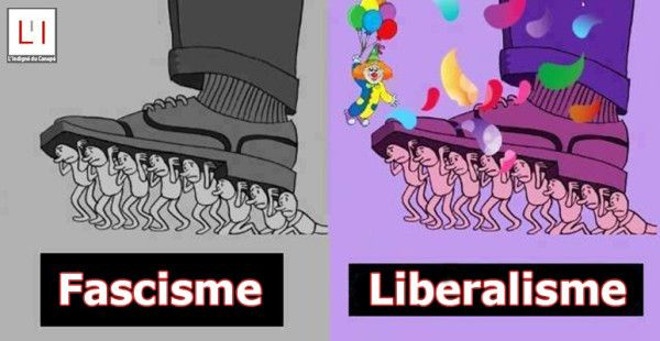
As ons na die ontploffing van geweld kyk wat hoofsaaklik in die Verenigde State losgebars het die afgelope paar maande kan ons konkludeer dat daar sprake is van ’n eindspel van een of ander aard. Duisende misleide jeugdiges is besig om amok te saai en om brute geweld te gebruik teen onskuldige winkeleienaars en willekeurige omstanders. Ondertussen is daar heelwat beelde op YouTube te sien (waarvan ‘n groot aantal ook al weer verwyder is) hoe winkeleienaars, oumense, vroue, kinders en selfs huisdiere die woede van die menigte moet ontgeld. As ‘n mens sou vra wat die rede is vir hierdie woede, word natuurlik verwys na die krimineel en dwelmgebruiker George Floyd wat ‘n dodelike slagoffer geword het van polisiegeweld nadat hy hom teen sy arrestasie verset het.
Wat hierdie protese interessant maak, is dat ons destyds dieselfde gesien het met die opkoms van fascisme in Italië en natuurlik die nasionaalsosialiste in Duitsland. En net soos die betogings van vandag, was die ekstreem nasionalistiese betogings van weleer ‘n produk van finansiering deur groot maatskappye. Mussolini het immers gesê dat ‘n mens fascisme net sowel korporatisme kan noem. As dit nie was vir die chemiebedryf IG Farben nie, sou Adolf Hitler waarskynlik nie meer as ‘n kanttekening in die geskiedenis gewees het nie.
Net soos wat die Nazi’s Joodse winkels en eiendomme vernietig het tydens die beruge Kristallnacht in November 1938, doen die hedendaagse Antifa en hul vennote Black Lives Matter presies dieselfde vandag. En net soos die perse en gegoede burgers in Duitsland hierdie terreur gesteun het, steun die perse en hoofstroom die BLM-betogings vandag. In die hiperskakel (‘n artikel uit 2017) gaan die skrywer selfs sover soos om te beweer dat “Antifa die mees redelike mense” in die VS geword het.
Inderdaad kan ons weereens verneem dat die groot bedrywe hierdie geweld gebruik om hul eie belange te bevorder. Die oproerkraaiers is bloot voetsoldate van die groot kapitaal.
Die vraag is egter: Wat is die verskil? Hoekom was ideologiese geweld vroeër sterk nasionalisties en hoekom is dit vandag sterk antinasionalisties?
Die antwoord sou te make hê met die bekende ou gemeenplaas, naamlik: volg die geld. Net soos die hoogs geïndustrialiseerde lande van Europa destyds met trots gevul was oor hul tegnologiese produkte, was die verleiding groot gewees om hulself as ‘n hoogs bekwame volk te sien. En hoe meer mense in die gehalte van hierdie produkte begin glo, hoe beter weerkaats dit terug op die prestasie van die volk. ‘n Goeie volk maak goeie produkte, en goeie produkte verkoop beter. So ontstaan daar ‘n suksessiklus. Die aandeelhouers van hierdie groot bedrywe was bykans almal landgenote van daardie bedrywe self gewees, en hierdie kapitaal het die nodige energie verskaf om nasionalisme as ‘n groot deug te sien.
En net soos vandag, het die voorbokke van hierdie bewegings radikaal entoesiasties geword totdat nasionalisme ‘n karikatuur van sy oorspronklike bedoeling geword het, en daarna het dit bergafwaarts begin gaan. So is Antifa en BLM besig om radikaal hul doel verby te skiet en ‘n karikatuur te maak van hul oorspronklike bedoeling. Hulle glo al lankal nie meer in die edelmoedigheid van die stryd nie, maar wil net chaos veroorsaak – as daar ooit sprake was van edelmoed, bygesê.
Aangesien bedrywe in ons tyd nie meer landsgebonde is nie maar vanweë globalisme internasionaal werksaam is, is dit nie meer bevorderlik om nasionalistiese sentimente by mense te bewerkstellig nie. Waar landsgrense destyds gedien het om bedrywe daartussen te koester en te ontwikkel, het hierdie bedrywe nou so groot geword dat landsgrense en valutabeheer as ‘n belemmering gesien word, en terwille van verdere groei en ontwikkeling presteer hierdie bedrywe nou beter sonder grense. Die grootaandeelhouers is ook nie meer mense vanuit dieselfde land nie, maar dit kan nou enige persoon wees orals ter wêreld. Vandaar dat die verleiding nou groot is om mense massaal te indoktrineer en te intimideer teen enige vorm van nasionalisme.
Die gevaar is egter dat sonder ‘n gesonde dosis nasionale identiteit, geloof en deug gaan volkere tot niet. Hulle word slegs na waarde geskat as hulle ‘n produktiewe bydrae kan lewer tot die groot geldmasjien. Sodra hulle geen betekenisvolle bydrae kan lewer nie, is hulle van ‘n eksistensiële ondergang verseker. Daar is geen sprake meer van die ouer generasie wat die jonger generasie met insig, wysheid en skoonheid opvoed nie, geen fakkel wat aan die nuwe generasie oorhandig word nie. Almal is soos kinders, die hoofstroommedia is die dominee, en repressiewe toleransie (die verdrukking van afwykende stemme) is die dogma.
Pleks van hierdie tradisionele strukture word daar nou ‘n nuwe stelsel opgerig wat verbasend ooreenstem met die 10 stappe van kommunisme, soos wat in die Kommunistiese Manifes staan. Die belangrikste verskil is dat Marx en Engels die staat as eienaar van alle produksiemiddele wil hê, maar vanweë die aard en omvang van hierdie bedrywe is hulle al lankal in die geleentheid om state onder hul beheer te bring. Agter die staat sit met ander woorde privaat eienaars. Tog is hul doelstellings vir die gewone mens dieselfde. John D. Rockefeller het mos op ‘n stadium gesê dat hy ‘n wêreld van werkers wil hê en nie ‘n wêreld vol denkers nie, soortgelyk aan Marx en Engels se ideaal van ‘n werkersparadys. So sien ons hoe kommunisme, die groot kapitaal en fascisme (gemaskeer as antifascisme) hul kragte gebundel het om nou in opstand te kom teen nasionale en kulturele belange.
Aangesien die grootste deel van die werkende bevolking vanweë die korona-epidemie vanuit die huis moet werk, weet ons ongetwyfeld wie hieraan verdien om die nuutste rekenaars en programmatuur te verskaf dat mense nog met mekaar kan vergader. Uiteraard gaan mense ook boeke en handelsware deur amazon.com bestel vanweë die kleinhandelaars wat hulle deure gesluit moet hou. Vervolgens het hierdie pandemie Jeff Bezos, Bill Gates en vennote tientalle miljarde dollars wins opgelewer, en in die geval van Bill Gates gaan hy nou entstowwe ontwikkel om ons met allerlei ongetoetste middele te vergiftig.
Die ironie is dat waar IG Farben destyds gifstowwe soos Zyklon B ontwikkel het, gaan IG Farben se dogteronderneming Bayer-Monsanto help om sy entstowwe te ontwikkel om die res van die wêreld siek te maak. En aangesien president Obama destyds die Monsanto Act bekragtig het, is hierdie bedryf gevrywaar van juridiese vervolging, en staan dus bo die wet.
Terwyl al hierdie narigheid gebeur is die elite besig om van die polisie ontslae te raak met hul “Defund the Police” aksies, en blykbaar is die rede hiervoor om voortaan mense gade te slaan met hommeltuie, kamera’s en ander tegnologiese middele. Dit beteken dat geregtigheid vanuit ‘n sentrale rekenaarkamer gaan geskied, en nie meer deur ‘n polisiekonstabel op die toneel nie. Die menslike oordeel is afwesig, wat dit makliker gaan maak om enige misdadige insident vir politieke doeleindes te misbruik. Immers, ‘n videobeeld wat buite konteks aan die publiek oorgedra word is ‘n skitterende propagandamiddel.
En so is die BLM/Antifa-oproerkraaiers geleidelik besig om die wêreld onveilig, grimmig en weerloos te maak. Goeie burgers is die nuwe kriminele en die kriminele is nou die moderne vryheidstryders. Hierdie chaos het suksesvol in Suid-Afrika gewerk en word nou wêreldwyd ingevoer. Dit mag dalk verklaar waarom die perse oorsee nooit veel aandag skenk aan die ernstige misdaadgolf in Suid-Afrika nie, en selfs hul bes probeer om dit stil te hou. Dit is moontlik ‘n strategie om die res van die wêreld slaapwandelend in hierdie nuwe distopia te lei deur te verwys na Suid-Afrika se “suksesverhaal”.
Ons leef in ‘n tyd waarin kunstenaars wat nie links genoeg is nie, geteiken word. Plaaslik is daar eintlik net ‘n enkele ideologie of narratief wat geduld word. Daaraan word uitdrukking gegee met woorde soos regstelling, transformasie, integrasie, assimilasie, nasiebou en verengelsing. Kerry Raymond Bolton (gebore in 1956) is ‘n Nieu-Seelander wat hom teen sulke modestrominge verset. In die verligte Wikipedia word hy as ‘n fascis, anti-semitis en selfs satanis uitgebeeld. Hy woon in Paraparaumu in die suidweste van die Noordeiland, maar word nie in die Wikipedia as ‘n “notable resident” beskou nie. In die konserwatiewe Metapedia word Bolton voorgehou as konserwatief en nasionalisties. Hy stry teen die valshede wat die massa-inligtigsmedia versprei, asook die deurtrapte linksheid van universiteite. In ‘n vorige rubriek het ek die aandag gevestig op Bolton se positiewe gesindheid jeens blankes in Rhodesië en Suid-Afrika (Praag 19.08.2016).
Ek het twee van Bolton se boeke gelees: Artists of the Right (San Francisco: Counter-Currents Publishing, 2012, 208p; Amazon Kindle $6,89) en More artists of the Right (San Franciso: Counter-Currents Publishing, 2017, 188p; Amazon Kindle $5,74). In die Kindle-verwysings hier onder word hierdie boeke as onderskeidelik I en II aangedui. Die teks van die 2012-boek, met die uitsondering van die hoofstuk oor HP Lovecraft,* bestaan uit verwerkings van artikels wat in ‘n vorige boek van Bolton, Thinkers of the Right (2003), gepubliseer is. Die teks van die 2017-boek bestaan uit die herpublikasie van artikels wat in Greg Johnson se tydskrif, Counter-Currents, verskyn het. Dit is veral literêre kunstenaars, soos digters, waarna in die twee boektitels verwys word.
[* Michel Houellebecq se eerste boek is nie fiksie nie maar ‘n biografiese essay oor die Amerikaner, HP Lovecraft (1890-1937), die outeur van die gedig, “On the creation of niggers” (1912). Dit was in die era voordat politieke byderwetsheid die Westerse wêreld getref het. Houellebecq skryf: Swartes se “vitality, their apparent lack of complexes or inhibitions, terrifies and repulses him [Lovecraft]. They dance in the street, they listen to music, rhythmic music … They talk loud. They laugh in public. Life seems to amuse them, which is worrying” (Michel Houellebecq, HP Lovecraft: Against the world, against life, London: Weidenfeld & Nicolson, 1991/2005, 247p, p 113). ‘n Land kan in sy swernoot gaan sonder dat oor die ramp wakker gelê word.]
Sommige van hierdie kunstenaars was aanvanklik kommuniste terwyl ander fasciste was wat selfs tot hulle einde fascisme aangehang het. In hierdie verband moet twee sake in gedagte gehou word. Enersyds kan enige ideologie wat aanhang geniet, afgesien daarvan of dit van ‘n politieke of religieuse aard is, ten minste teoreties oor sekere positiewe kenmerke beskik, wat die onderskrywing daarvan vir die volgelinge sinvol maak. As dit nie so was nie, sou daar nie aanhangers gewees het nie. Andersyds was dit veral tussen die twee wêreldoorloë vir baie eerbare, vooraanstaande mense moeilik om tussen kommunisme en fascisme te besluit, onder meer omdat die gevolge van hulle toepassing in die praktyk toe nog nie bekend was nie.
Vóór die Tweede Wêreldoorlog tydens die Spaanse Burgeroorlog (1936-1939) was dit by Britse literatore, bv George Orwell, in die mode om hulle by die kommuniste te skaar. TS Eliot, daarenteen, was ‘n uitsondering deurdat hy geweier het om kant te kies (Bolton II 915). Tydens die Tweede Wêreldoorlog was Brittanje vir sy voortbestaan van Russiese militêre steun afhanklik en is daar amptelik geen kritiek op die Sowjetunie en kommunisme uitgespreek nie. Byvoorbeeld, die Katyn-massamoord van Pole deur Russiese soldate is doelbewus verswyg (Praag 22.01.2017). Ná die Tweede Wêreldoorlog is veral fascisme in die Weste as boos verwerp; mettertyd ook kommunisme, maar nooit in dieselfde mate as fascisme nie. In werklikheid het kommunisme oor ‘n baie langer tyd, in veel groter mate en in meer lande as fascisme dood en verwoesting gesaai. Desnieteenstaande word fascisme tans in baie groter mate as kommunisme verdoem. Soos rassisme is fascisme deesdae ‘n skelwoord vir onrehabiliteerbare boosheid. Albei terme word feitlik uitsluitlik teen blankes gebruik. Dit is asof voorgegee word dat swartes per definisie nie rassisties of fascisties kan wees nie.
Dit is moeilik om presies te bepaal wat onder polities regs verstaan word. Bolton beskou fascisme as regs en kommunisme as links. In hierdie opsig aanvaar hy dus die populêre standpunt, maar dit is vir my problematies. Tussen kommunisme en sosialisme is daar eerder ‘n graad- as ‘n aardverskil. Die ANC-regime noem homself sosialisties omdat hy nie die moed en eerbaarheid het om te erken dat hy wesenlik kommunisties is nie. In soverre die ANC nog nie volskaals kommunisties is nie, is dit sy strewe om ingevolge die Vryheidsmanifes van 1955 ‘n volslae kommunistiese regime te word. Buite Duitsland was dit eerder Benito Mussolini se gematigde fascisme as Adolf Hitler se radikale fascisme wat deur intellektuele aangehang is. Maar Mussolini het sy weergawe van fascisme uit sosialisme ontwikkel – “The only doctrine of which I had practical experience was that of socialism” (Benito Mussolini, The doctrine of Fascism, 1932, 50p; Amazon Kindle $1.14, 163) – vandaar my skeptisisme oor die beweerde politieke regsheid van fascisme. Nadat hy uit die Sosialistiese Party geskop is, het Mussolini beweer dat hy teen sosialisme gedraai het, maar voeg dan by: “Fascism recognizes the real needs which gave rise to socialism and trade unionism” (110), terwyl ek eerder niks met sosialisme en vakbonde te make wil hê nie.
Wat baie van die kunstenaars genoem in Bolton se twee boeke tot die aanvaarding van tydelike of permanente fascisme beweeg het, is die volgende uitspraak van Mussolini: “Poetry is a necessity of state” (Bolton I 1711). “This displayed a higher state of civilization” (I 1711). Maar hieruit het kunstenaars soos DH Lawrence, Ezra Pound en Wyndham Lewis afgelei “that the artist is the natural ruler of humanity” (I 2050). Dit is ‘n uiters onrealistiese, romantiese siening as dit op politieke leierskap toegepas sou word. By die verskaffing van kulturele leiding kan so ‘n standpunt egter meer sinvol wees, bv “Lewis calls for a ruling caste of aesthetes” (I 2188). In sy genoemde boek het Mussolini die waarde van kultuur (63) en tradisie (84, 504) – “moral and traditional values” (524) – beklemtoon en materialisme teengestaan (84, 242). Dit pas in die kraal van konserwatiewe kunstenaars; ook omdat sowel kommunisme as kapitalisme materialisties is (Bolton I 1658, 2807, 2901). Op ‘n enkele uitspraak of handeling van ‘n politikus – soos dié van Mussolini: “Poetry is a necessity of state” – moet liefs nie peil getrek word nie. Dit is soos om die terroris Nelson Mandela, wat nooit geweld afgesweer het nie, as ‘n vredesikoon te beskou omdat hy versoening gepredik het eers nadat hy in sy bose doel geslaag het, naamlik die daarstelling van ‘n swart politieke bewind.
Wat by die lees van Hitler se Mein Kampf en Mussolini se The doctrine of Fascism opval, is hoe onspesifiek hulle opvattings in baie opsigte is. Hulle idees kan alleenlik na behore beoordeel word ingevolge hulle praktiese toepassing. Waaraan ek ‘n hekel het, is die verabsolutering van die staat. Soos Mussolini dit stel: “The State is all embracing … Fascism is totalitarian” (103). “For Fascism the State is absolute, individuals and groups relative” (333). “The individual exists only in so far as he is within the State and subjected to the requirements of the State and … as civilization assumes aspects which grow more and more complicated, individual freedom becomes more and more restricted” (544). Ek, daarenteen, verkies beperkte staatsmag en groter individuele vryheid. Mussolini skryf: “Without the State there is no nation” (645). “It is the State which creates the nation” (128), soos die ANC-regime tans plaaslik probeer doen. Mussolini definieer fascisme as “an organized, centralized, authoritarian democracy” (275). Dit is vir my absoluut verwerplik. Laat die “organized” weg omdat die ANC-regime in chaosskepping uitmunt. Die ANC-bewind is sekerlik “centralized” en “authoritarian” hoewel geensins demokraties in die sin dat daar oor die belange van al die inwoners gewaak word nie. Byvoorbeeld, Cyril Ramaphosa gaan voort om oor plaasmoorde te swyg pleks van dit ondubbelsinnig te veroordeel. Nie-blankes, veral swartes, word doelbewus bevoordeel en blankes soveel moontlik benadeel. Soos die ANC en ander kommunistiese regerings noem Mussolini sy volgelinge kamerade (481).
Waar ek roerend met Mussolini eens is, is wanneer hy skryf: “Fascism is … opposed to the form of democracy which equates a nation to the majority, lowering it to the level of the largest number” (116). Tereg verkies hy kwaliteit bo kwantiteit. “Fascism … asserts the irremediable and fertile and beneficent inequality of men who cannot be leveled by any such mechanical and extrinsic device as universal suffrage” (253). Naas biologiese kenmerke, soos asemhaal, is geen twee mense of groepe in Suid-Afrika gelyk of eenders nie – nie eens meer in die howe nie omdat uitspraak daar gelewer word deur mense wat dikwels op grond van ras en geslag pleks van bekwaamheid aangestel en bevorder is. Dit is absoluut absurd dat alle volwasse Suid-Afrikaanse burgers desnieteenstaande gelyke en eenderse stemreg het. In die praktyk sien ons daagliks dat “political equalitarianism” tot “the habit of collective irresponsibility” lei (275).
Myns insiens is die ANC se huidige skynbare aanhang van demokrasie vals. Omdat hy die steun van die meerderheid swart kiesers het, het demokrasie ‘n manier aan die ANC gebied om aan die bewind te kom en na ‘n kwarteeu steeds aan die bewind te wees. Maar die ANC regeer primer ten bate van die swartes en ter benadeling van veral die blankes. Ons “jong demokrasie” is nie daar om al die land se inwoners te bevoordeel nie. Bolton skryf met verwysing na Friedrich Nietzsche (1844-1900) oor sommige van sy geselekteerde kunstenaars: “[They] were suspicious if not terrified of the mass leveling resulting from democracy and its offspring communism.* In democracy and communism, they saw the destruction of culture understood as the pursuit of the sublime” (Bolton I 156). As daar iets is waaraan die ANC-regime heeltemal onskuldig is, is dit die geestelike veredeling van die bevolking. Pleks daarvan word die samelewing al hoe meer gebrutaliseer. Wat DH Lawrence die “choice minority” noem (I 156), vind dit in die nuwe Suid-Afrika al hoe moeiliker om leefbare ruimte te vind.
[* Dit kan ook van sosialisme gesê word: “socialism as a leveling creed: ‘the scum on the democratic cauldron'” (II 738). Wyndham Lewis skryf: “No artist can ever love democracy or its doctrinaire and more primitive relative, communism” (I 2138). Oor “mass leveling” skryf Lewis: “[The] mass mind … is required to gravitate to a standard size to receive the standard idea” (I 2159). Hierdie uitspraak kan op sowel demokrasie as die massa-inligtingsmedia toepaslik wees.]
In Bolton se 2012-boek is daar ‘n hoofstuk oor elk van die volgende tien kunstenaars: DH Lawrence, HP Lovecraft, Gabriele D’Annunzio, Filippo Marinetti, WB Yeats, Knut Hamsun, Ezra Pound, Wyndham Lewis, Henry Williamson en Roy Campbell. In Bolton se 2017-boek is daar ‘n hoofstuk oor elk van die volgende sewe kunstenaars: Richard Wagner, Aleister Crowley, TS Eliot, PR Stephensen, ARD Fairburn, Geoffrey Potocki de Montalk en Yukio Mishima. Mishima (1945-1970), ‘n Japannees, is die enigste Oosterling onder hierdie kunstenaars. Dit is moeilik om in te sien in watter opsig hy in Westerse sin regs was. Die hoofstukke is nie almal ewe interessant of duidelik polities regs nie. Ek skryf selektief oor hierdie kunstenaars; veral oor wat van aktuele belang of hopelik interessant is.
In sy voorwoord noem Greg Johnson dat hierdie kunstenaars oor talle onderwerpe verskillende opinies huldig. “Yet to a man, they were united in their rejection of human equality – the common root of capitalism and communism – and their affirmation of a hierarchical model of society” (I 46). “As Rightists, these artists rejected modern decadence and sought to preserve and restore healthier pre-modern social forms within the context of modernity” (I 54). Party kunstenaars hunker terug na die voor-industriële landbou-era, selfs die heidense tyd. Maar daar is ook dié wat gevorderde tegnologie en futurisme omarm, bv die Italianer, Filippo Marinetti (1876-1944). In plaas van demokrasie word dikwels voorkeur aan ‘n natuurlike, nie-oorgeërfde aristokrasie, oftewel elite, en ‘n monarg eerder as ‘n diktator as staatshoof gegee. Emosie, gevoelens, impulsiwiteit en instinkte word deur bv die Brit, DH Lawrence (1885-1930) hoog aangeslaan, wat die gevaar van irrasionaliteit inhou.
Wyndham Lewis “rejected the counter-movement that sought to return to the past and embrace the intuitive, the emotional, and the instinctual above the intellectual and the rational. Lewis particularly denounced DH Lawrence for his espousal of instinct above reason and for what appeared to be a celebration of the doctrine of the ‘noble savage’, which has served as the basis of liberalism from the eighteenth century on” (I 1904). Lewis het ‘n groot kramp gehad in “parlor pink liberals” (I 1921), soos die lede van die Bloomsbury-groep, “the pretentious and snobbish intellectual denizens of a delineated area of London who could make or break an aspiring artist or writer” (I 1921). Lewis het teen hulle uitgevaar in sy roman, The Apes of God (1930). Roy Campbell het op ‘n soortgelyke manier gereageer in sy gedig, The Georgiad (1931).
As sodanig is die lewe nie noodwendig sinvol nie. Iedere mens moet poog om self soveel moontlik betekenis aan sy lewe te gee. Wat volgens Lovecraft nagestreef behoort te word, is “self-actualization and higher cultural and spiritual activities” (I 237). “The primary goal of a nation [is] the development of high aesthetic and intellectual standards” (I 274). “The only meaning of human existence is to reach ever higher levels of mental and aesthetic development” (I 308). “Leisure will be that of a civilized person rather than that of a cinema-haunting, dance-hall frequenting, pool-room loafing clod” (I 282). “Socialism, like capitalism, would pave the way for universal proletarianization and the consequent leveling of culture” (I 256). “Democracy is a false idol – a mere catchword and illusion of inferior classes” (I 297). Meerderwaardigheid “could not be achieved through ‘the low cultural standards of an underdeveloped majority. Such a civilization of mere working, eating, drinking, breeding, and vacantly loafing or childishly playing isn’t worth maintaining'” (I 308).
Die Italianer, Gabriele D’Annunzio (1863-1938), het tot ‘n uitsonderlike insig gekom: “The State should always be no more than an institution for favoring the gradual elevation of a privileged [talented] class towards its ideal form of existence” (I 413). Sedert 1994 doen die ANC-regime presies die teenoorgestelde in Suid-Afrika. D’Annunzio het sy ideale kortstondig in die vrye stadstaat Fiume/Rijeka ‘n werklikheid gemaak (1920-1924). Hierdie hawestad was in die 20ste eeu agtereenvolgend Oostenryk-Hongaarse, Italiaanse, Joego-Slawiese en Kroatiese besit. Ná die Italiaanse oorgawe in 1943 het Duitsland Rijeka beset. In 1945 was daar 27 000 Duitse soldate wat Rijeka teen Joego-Slawiese aanvalle verdedig het. Hiervan is 16 000 gevange geneem en 11 000 gedood, baie van hulle nadat hulle oorgegee het. Die Joego-Slawiese regering van Tito (1892-1980, staatshoof 1943-1980) – die Weste se gunsteling-kommunis – het valslik outonomie aan die Italiaanse inwoners van Rijeka belowe. Nadat die Tito-kommuniste beheer oorgeneem het, is diegene wat outonomie begeer het sistematies verdryf. Minstens 650, hoofsaaklik Italianers, is ná die oorlog tereggestel. Oor hierdie ernstige kommunistiese oorlogsmisdade word geswyg. Maar wanneer die blanke regering in Suid-Afrika ‘n krotbuurt en misdaadnes soos Distrik 6 opruim of enkele of ‘n paar dosyn swart skoorsoekers dood, is daar na bewering ‘n misdaad teen die mensdom gepleeg. Tydens die “bevrydingstryd” is daar sekerlik baie meer swartes deur swartes as deur blankes gedood. Ná ons “bevryding” in 1994 is heel moontlik meer blankes deur swartes gedood as die dodetal wat aan blankes tydens die “bevrydingstryd” toegeskryf kan word.
Die Ier, WB Yeats (1865-1939), “is condemning the leveling effects of the democratic media, pandering to the lowest denominator for the sake of maximum profit via the largest market, part of a general commodification of culture, which was why Yeats, like Lawrence, Wyndham Lewis, Pound, et al, deplored the democratization process”(I 1001). “Yeats advocated planned human upbreeding and joined the Eugenics Society at a time when eugenics* was a widely held belief among the intelligentsia” (I 1063). “Psychometric studies … showed intelligence to be inherited, and [Yeats] expressed concern at the proliferation of the unintelligent” (I 1086). Yeats “was suspicious of any movement that appealed to the masses” (I 1173). Hy het sy lewe lank weerstand teen vulgariteit gebied en die bevordering van hoë kultuur bepleit (I 1183).
[* Eugenetiek: “wetenskaplike ondersoek van alle faktore wat ‘n ras kan verbeter” (HAT). Suiwer rasioneel behoort daar nie beswaar teen die verbetering van etnisiteite, rasse en die mensdom te wees nie. Teen die (verdere) verslegting van mense behoort daar wel gewaak te word.]
Die Noorweegse Nobel-pryswenner, Knut Hamsun (1859-1952), was ‘n interessante, eiesoortige, aartskonserwatiewe gees. “Hamsun attacked the crass materialism of the US. He despised democracy as a form of despotism, abhorring its leveling nature and mob politics … He also expresses his misgivings about the presence of Africans in the US” (I 1253). “His constant theme [the] rediscovering [of] one’s roots in the simple life, in family, and in children” (I 1286). “As [Oswald] Spengler [1880-1936] noted, there is nothing more important than the continuation of a family lineage, generation after generation … there is nothing more dreadful than being the last of a family’s line” (I 1324). Maar kulturele marxiste wil juis die tradisionele gesin, die kern van Westerse beskawing, vernietig. Homoseksuele doen lustig hieraan mee. Spengler skryf: “A woman of race* does not desire to be a ‘companion’ or a ‘lover’, but a mother … barrenness is the hardest curse that can befall a woman and through her the race” (I 1332).
[* “By ‘race’ Sprengler did not [mean] a biological, or ‘Darwinistic’ conception, but an instinct. ‘Race’ means ‘duration of character'” (I 3776).]
Hamsun “had been appalled by the British war against the Boers, which he would surely have regarded as a war by a plutocratic power against an entire folk who epitomised a living remnant of the type portrayed by Isak in [Hamsun’s novel] The growth of the soil” (1917) (I 1445).
‘n Soortgelyke pro-Afrikanergesindheid word by die Nieu-Seelander van Poolse oorsprong, Geoffrey Potocki de Montalk (1903-1997), aangetref. Om sy afkeur tuis te bring het hy “english” (II 2527) en “jews” (II 2505) met kleinletters geskryf. In 1964 het Potocki Two blacks don’t make a white: Remarks about apartheid gepubliseer. Daarin spreek hy uit “a cynicism in regard to humanitarianism as a façade for ignoble purposes … Potocki’s outlook on South African apartheid was based decidedly on the general inferiority of the blacks to whites, insofar as they had not, and could not, make a civilization” (II 2566). “Attacks on apartheid, Potocki claimed, were the result of the post war era of ‘univeral humbug’, the product of a coalition of Christians, communists, and democrats. He pointed to the selective hypocrisy of the liberal conscience, which was silent about communist dictatorships, and to the record of the British Empire in their treatment of colored colonials. He drew heavily on South African government publications citing the services that had been rendered to the blacks under apartheid, pointing out that the Afrikaners did not dispossess indigenous blacks, but had met the Xhosa while both were migrating from opposite directions” (II 2576).
Op 11 November 1965 het Ian Smith Rhodesië eensydig onafhanklik verklaar. “In 1966, Potocki took up the cause of Rhodesia. His solution to the crisis was … to proclaim Rhodesia a Kingdom … ‘In this way the Rhodesians will set the whole world a good example, take the wind out of the sails of the minority of piratical hypocrites in England, & provide a turning-point for the Good in the history of the world, at a time when it never needed it more'” (II 2586). “In 1977 Potocki returned to Southern African themes, namely: ‘Let the Rhodesians not be surprised that England should try to sell them down the river to a gang of bolsheviks and other terrorists. For after having plotted the most gigantic blood-bath and world-wide flood of misery that the world has ever seen, and carried it through by fiendish means (Dresden etc) backed up by Hellish lies (six millions etc) on the pretext of safeguarding the independence and territorial integrity of Poland, England shamelessly sold that great country (once the largest kingdom in Europe) to the wickedest terrorist of known history, calling himself Stalin'” (II 2595).
Die Amerikaner, Ezra Pound (1885-1972), “regarded the rise of materialism, democracy, and the masses as detrimental to the arts, as newspapers and dime novels replaced literature, and the mass market determined cultural expression. Pound saw artists or what we might call the ‘culture-bearing strata’ as a class higher than the general run of humanity who, under the regime of the democratic era, had been leveled down to a ‘mass of dolts’, a ‘rabble’, whose redeeming feature was to be ‘the waste and manure’ from which grows ‘the tree of the arts'” (I 1617). “Culture were the product of races, and each race had its own soul … of which the artist was the guardian” (I 1711).
Naas Nietzsche en Spengler put sommige van hierdie kunstenaars inspirasie uit Thomas Ernest Hulme (1883-1917) se werk. In Robert Ferguson se biografie, The short sharp life of TE Hulme (London: Faber & Faber, 2012, 342p; Amazon Kindle $16,09), word Hulme beskryf as “the conservative character at its best.” “Both Pound and Lewis were influenced by the Classicism of the art critic and philosopher TE Hulme, a radical conservative. Hulme rejected nineteenth-century humanism and romanticism in the arts as reflections of the Rousseauian (and ultimately communistic) belief in the natural goodness of man when uncorrupted by civilization, and of human nature as infinitely malleable by a change of environment and social conditioning” (I 1962). Dit is hierdie dwaasheid van Jean-Jacques Rousseau (1712-1778), wat oorerwing/DNS buite rekening laat, wat aan die grondslag lê van wat ons deesdae daagliks moet aanhoor: As alle mense dieselfde geleenthede het, sou die uitkoms glo wees dat almal gelyk is; dus net so goed, bv intelligent, bekwaam, toegewyd, ens, as ander mense. In die praktyk sien ons egter dat gelyke geleenthede nie gelyke uitkomste verseker nie. Selfs superieure geleenthede, soos die hedendaagse blatante bevoordeling op grond van ras, lei plaaslik dikwels tot teleurstellende resultate.
Hulme skryf: “The root of all romanticism: that man, the individual, is an infinite reservoir of possibilities; and if you can so rearrange society by the destruction of oppressive order then these possibilities will have a chance and you will get progress” (I 1972). Dit herinner my aan die rektor wat swart studente nie op grond van bewese akademiese prestasie tot universitêre studie wou toelaat nie, maar op grond van potensiaal. Ek het toe aan hom gesê hy moet vir my ‘n swarte uitwys wat nie potensiaal het nie. Hy kon nie met ‘n sinvolle reaksie vorendag kom nie.
Hulme skryf voorts: “One can define the classical quite clearly as the exact opposite to this [cf previous paragraph]. Man is an extraordinarily fixed and limited animal whose nature is absolutely constant. It is only by tradition and organisation that anything decent can be got out of him … Put shortly, these are the two views, then. One, that man is intrinsically good, spoilt by circumstance; and the other that he is intrinsically limited, but disciplined by order and tradition to something fairly decent” (I 1979). Dit lyk na oordrywing om te beweer dat die menslike natuur “absolutely constant” is. Mense kan myns insiens individueel en groepgewys bv (moreel) verbeter of versleg.
Die Brit, Wyandham Lewis (1882-1957), onderskryf Hulme se opvattings. By Lewis vind ek ook ondersteuning vir sommige van my ander standpunte: “Lewis opposes the ‘melting pot’ where different races and nationalities are becoming indistinguishable. Once again, Lewis’s objections are aesthetic at their foundation. The Negro gift to the white man is jazz, ‘the aesthetic medium of a sort of frantic proletarian subconsciousness’, degrading and exciting the masses into mindless energy, an ‘idiot mass sound’ that is ‘Marxistic’. We might reflect now that this was the beginning of the process upon which the modern music industry is largely founded, with ‘popular’ music – the transient music of the mass market – centered around frenetic rhythms accompanied often by a frenzied pseudo-tribal dancing, symptomatic of the return [of] the ‘cult of the primitive’ in the name of ‘progress'” (I 2197).
Die Brit, Henry Williamson (1895-1977), spreek tereg sy afkeur van die twee wêreldoorloë uit omdat “the youth of Europe shed the blood of their own family, and the jackals of the world grew fat” (I 2551). ‘n Kolossale onnoselheid in dieselfde orde as FW de Klerk se magsoorgawe in 1994 is: “the Soviets had been permitted to invade half of Europe” (I 2540) in 1944/45 en is daarna toegelaat om hierdie besetting tot in 1990/91 voort te sit. Roy Campbell, Lewis se “literary ‘bodyguard'” (I 2724), “was horrified by the Allied victory that had placed half of Europe under the USSR” (I 2983).
Roy Campbell
Roy Campbell (1901-1957) is die enigste Suid-Afrikaanse kunstenaar wat in Bolton se twee boeke aan die orde gestel word. Campbell was sterk teen marxisme gekant en het hom tydens die Spaanse Burgeroorlog aan die kant van Francisco Franco se nasionaliste geskaar. Campbell het hom teen Adolf Hitler se fascisme uitgespreek maar dié van António Salazar gesteun. Hy wou egter nie lid van Oswald Mosley se Britse fascistiese party word nie (I 2814). Campbell was erg beswaard oor Britse kolonialisme. Hy het hom ook spoedig van die Bloomsbury-groep se “sex-socialism” (I 2713) gedistansieer. Volgens hom was hulle “intellectuals without intellect.” Bloomsbury was aanvanklik “impressed with his rough manners and hard drinking” (I 2620). “The robust Campbell found their refined manners, pervasive homosexuality, and pretentiousness sickening” (I 2680).
Campbell’s “own aesthetics, as the basis of his rejection of liberalism and socialism, was a synthesis of the romanticism of Provence and the classicism of the Greco-Romans” (I 2704). “Campbell explains that a hypocritical ‘humanitarianism’ is the ‘ruling passion’ of the British intelligentsia, which ‘sides automatically with the Dog against the Man, the Jew against the Christian, the black against the white, the servant against the master, the criminal against the judge'” (I 2889). In 1931 het Campbell profeties geskryf: “The liberal-democratic European idea is doomed, for in its tendency toward petty franchises and nationalisms and in its superficial idea of ‘freedom’, it is anarchistically hostile to the organization of the white race as a whole, and is one of the chief causes of the decline of European power” (I 2735). Campbell het ‘n weersin in industrialisering en tegnologie gehad. “He never used a typewriter or learned to drive” (I 2795).
Campbell het geprotesteer toe bruin mense se stemreg in die jare vyftig in Suid-Afrika weggeneem is. Bolton skryf: “However, Campbell’s misgivings about the South African situation were not prompted by the liberal desire for a democratic, monocultural state. He feared that antagonism between the races would result in Bolshevism and the destruction of his rustic ideal. With the advent of black rule, free market capitalism was ushered in on the wings of Marxism and revolution, which would hardly have surprised Campbell. Today the ANC calls globalization and trade liberalization the ‘correct path to Marxism-Leninism'” (I 3003). In nog ‘n opsig het Campbell dus die toekoms korrek voorspel. In 1954 het die Universiteit Natal ‘n eredoktorsgraad aan Campbell toegeken. “In an off-the-cuff speech, much to the embarrassment of the liberal audience, he defended South Africa against England’s condemnation of apartheid, ridiculing Churchill and Roosevelt, who had sold ‘two hundred million natives of Europe’ to the far worse slavery of Bolshevism” (I 3003).
Campbell is in 1922 met Mary Garman (1898-1979) getroud, die oudste van die sewe Garman-susters. Van hulle word op die Amazon-webwerf gesê: “Their morals were unconventional: bisexuality, unfaithfulness and illegitimate children were a matter of course.” In Connolly se boek (kyk hier onder) word drie van die Garman-susters in besonderhede beskryf. Mary was, soos Virginia Woolf (1882-1941), een van Vita Sackville-West (1892-1962) se minnaresse. Woolf het haar boek, Orlando (1928), na aanleiding van Mary se verhouding met Vita geskryf. Terwyl die Campbells in Frankryk gewoon het, het Uys Krige (1910-1987) daar opgedaag. Hy was veronderstel om onderwys aan die Campbells se twee kinders te gee, maar het ook ‘n seksuele verhouding met Mary gehad. Kathleen Garman (1901-1979) het met die beeldhouer, Jacob Epstein (1880-1959), getrou. Lorna Garman (1911-2000) was met die uitgewer en kommunis, Ernest Wishart (1902-1987), getroud, maar Laurie Lee (1914-1997)* het ‘n kind by haar verwek en sy het later ook ‘n seksuele verhouding met die skilder, Lucian Freud (1922-2011), gehad. ‘n Vierde Garman-suster, die tweede oudste Sylvia (gebore in1899), het haar onderskei as moontlik die enigste vrou wat seksueel met TE Lawrence (Lawrence of Arabia, 1888-1935) verkeer het. Nog ‘n Garman-suster, Ruth (gebore in 1909), het vyf kinders gehad, waarvan twee binne die huwelik was. Daar was twee Garman-broers, Douglas en Marvin, albei kommuniste. Douglas het ‘n tyd lank saam met Peggy Guggenheim (1898-1979), ‘n welgestelde bevorderaar van die skone kunste, gewoon.
[* In hoofstuk 7 van sy boek, As I walked out one midsummer morning (Harmondsworth: Penguin, 1971/1975, 186p; Amazon Kindle $14,58) vertel Laurie Lee van sy ontmoeting met die Campbells in Toledo, Spanje. Roy het toe van Mary gesê: “She’s got more genuine saintliness in her little finger than the whole of this god-damn town” (p 115). Lee skryf Roy “loved the Afrikaans language and described its primitive vigour” (116).]
Die agnostiese Campbell “at the initiative of his wife converted to Catholicism in 1935” (Bolton I 2787). Vóór dit was Mary allermins soos ‘n non, maar sy het fanaties godsdienstig geword en sowel Kathleen as Lorna beïnvloed om dieselfde te doen. Heiligheid is egter nie maklik volhoubaar nie. Mary “lost her faith about two years before she died. It seemed to disappear suddenly and without reason, like a bird alighting from a branch” (Cressida Connolly, The rare and the beautiful: The lives of the Garmans, London: Harper, 2005, 281p, p 225). Hierdie boek is deur Johannes Comestor op LitNet (28.10.2011) bespreek.
Volgens die Duitse komponis, Richard Wagner (1813-1883), “the noblest of all races was the ‘white'” (Bolton II 313). Ruimte ontbreek om Wagner se idees te bespreek wat later deur die Naziis as ondersteuning van fascisme en anti-semitisme vertolk is. Hy was “an aesthete who is instinctively repelled by the mob and its leaders” (II 208). Wagner skryf: “I am neither a republican, nor a democrat, nor a socialist, nor a communist, but an artistic being” (II 342). Vir hom het dit gegaan om “the völkisch basis of art … the artist as expressing the Volk-soul” (II 293). Wagner het onder meer gesteun op die nasionalisme van Johann Gottfried Herder (1744-1803 – II 105) en Johann Gottlieb Fichte (1762-1814 – II 95). Volgens Herder “the vehicle of living culture is a distinct Volk or nation with its distinct language and traditions” (Dagobert D Runes, ed, Dictionary of Philosophy, New York: Philosophical Library, 1942, p 125). Fichte word as die vader van Pan-Duitsheid beskou omdat hy Duitssprekendes geïnspireer het om teen die Napoleontiese besetting in opstand te kom.
Die Brit, Aleister Crowley (1875-1947), het soos baie van hierdie kunstenaars geen vertroue in verkiesings en demokrasie gehad nie: “The elected man is always the mediocrity; he is the safe man, the sound man, the man who displeases the majority less than any other, and therefore never the genius” (Bolton II 716).
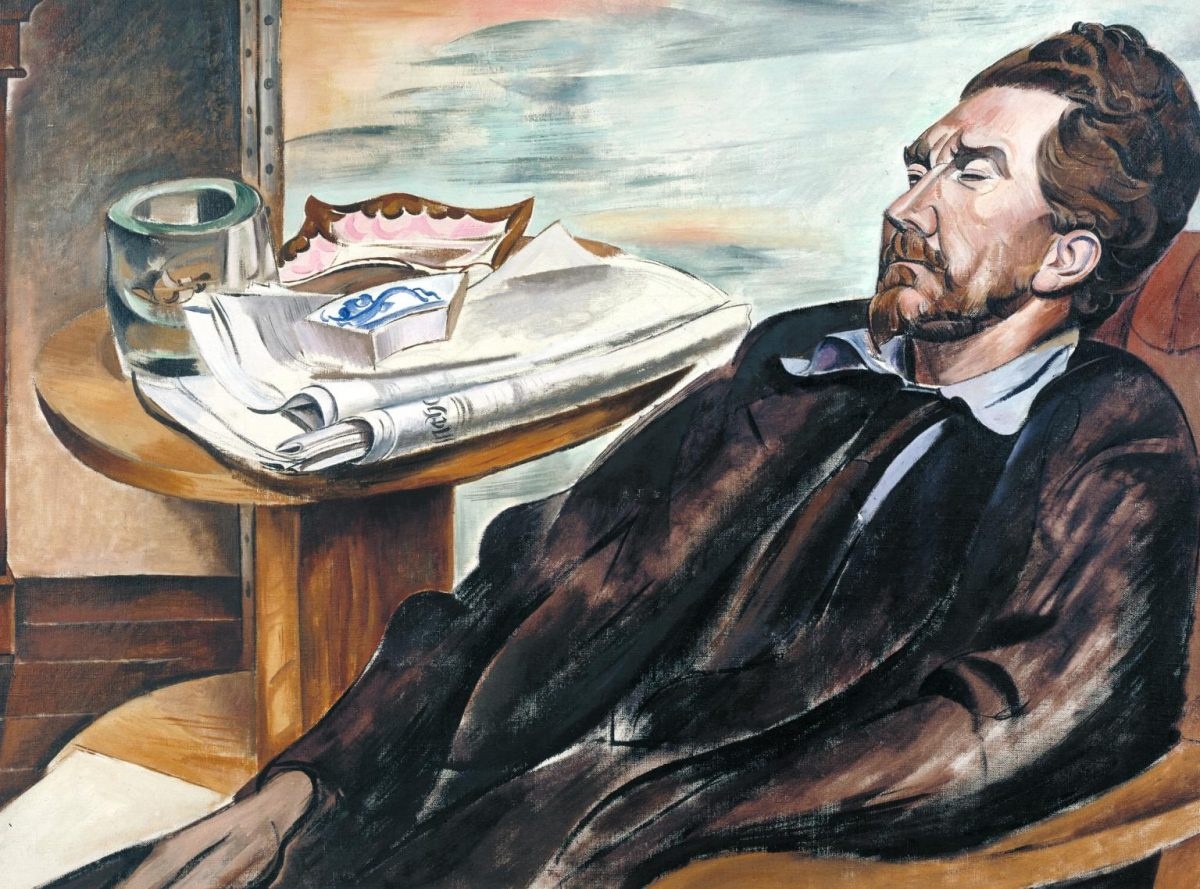
Skildery van T.S. Eliot deur Wyndham Lewis.
Die Amerikaner, T(homas) S(tearns) Eliot (1888-1965) het hom in 1915 in Engeland gevestig en in 1927 Britse burgerskap aanvaar; “a resident alien” (II 790). Hy was besorgd oor die nieu-barbaarsheid waardeur verworwe Westerse beskawing ondermyn word (II 781). Globalisme het tot kulturele pessimisme aanleiding gegee (II 797). Sy Notes towards the definition of culture (1948) “are particularly cogent expressions of Eliot’s criticism of liberalism and commercialism and his apologia for tradition” (II 807). In 1948 is die Nobel-prys vir letterkunde aan hom toegeken. “He never compromised his views in a post-1945 world in which democracy and egalitarianism had assumed idolatrous veneration” (II 816). Tereg was hy van mening “that tradition can only develop where the population is homogeneous” (II 874).
“His aim was to revive religion as the foundation for a cultural, aesthetic outlook” (II 904). Eliot “enthused about visiting Westminster Abbey and other great churches in London. Looking at their great architecture, Eliot saw the living embodiment of a past high culture” (II 937). In 1925 is sy gedig, “The Hollow Men”, gepubliseer. “‘Hollow Men’ … [have] no attachment, no place in a living tradition” (II 1034). Hy het multikulturalisme verwerp. “What is required for a tradition to become established is a sense of place and permanence” (II 1141). “A class-structured society … is a ‘natural society'” (II 1258). “A mob will be no less a mob if it is well fed, well clothed, well housed, and well disciplined” (II 1208). “Eliot saw the [Second World] War as having ruined the unity of European culture” (II 1236). “The cultural health of Europe required that the culture of each country should remain unique” (II 1300).
Eliot het twee boeke met kultuur as kernonderwerp gepubliseer: The idea of a Christian society (1939) en Notes towards the definition of culture (1948). By Amazon is albei saam as ‘n Kindle-weergawe verkrygbaar onder die titel, Christianity and culture (New York: Harcourt, Brace, 1948). Vir Eliot het dit om Europese kultuur gegaan. Hy het die intieme verband tussen kultuur en beskawing uitgewys. Hy het ook tussen die kultuur van ‘n individu, groep en samelewing onderskei, asook lae of populêre en hoë kultuur. Alle kultuur, oftewel lewenswyse, was volgens hom gebonde aan religie; in die Weste spesifiek aan die christelike religie, waarvan hy ‘n sterk voorstander was. Hy skryf oor “the essential relation of culture to religion … No culture has appeared or developed except together with a religion” (TS Eliot Kindle 1182). In ons gesekulariseerde era word hierdie standpunt deesdae bevraagteken.
Die meer skeptiese Matthew Arnold (1822-1888) het ‘n onderskeid tussen kultuur en religie getref. Daarom het Eliot die standpunt van Arnold gekritiseer en “Christian culture as the highest culture” gepostuleer (1506). Eliot het die werklikheid van klasverskille erken. Sy uitgesproke voorkeur was vir hoë kultuur en hoë beskawing. Daarenteen was die ambisieuse Arnold se siening: “Culture being a pursuit of our total perfection, by means of getting to know, on all matters which most concern us, the best which has been thought and said in the world” (Matthew Arnold, Cuture and anarchy: An essay in political and social criticism, 1869; Amazon Kindle $0, 43). “A man’s life of each day depends for its solidity and value on whether he reads during the day, and, far more still, on what he reads during it” (51). Soos Arnold dit dikwels gestel het: Hy was op soek na volmaaktheid, na “sweetness and light” (bv 115, 248).
Terug na Eliot se boek. Let op sy sobere siening: “All positions in society should be occupied by those who are best fitted to exercise the functions of the positions” (1550). “Qualitative differences between individuals must still be recognised, and … the superior individuals must be formed into suitable groups, endowed with appropriate powers … these groups are what we call elites” (1541). “This higher level of culture must be thought of both as valuable in itself, and as enriching the lower levels” (1569). “The primary channel of transmission of culture is the family” (1654). “The elimination of an upper class at a more developed stage can be a disaster for a country” (1717). Die nuwe Suid-Afrika kan as ‘n tragiese toonbeeld hiervan dien.
Die Australiër, Percy Reginald (Inky) Stephensen (1901-1965), het ‘n eiesoortige Australiese kultuur wat duidelik van dié van die Britte verskil asook nasionale selfrespek bepleit (Bolton II 1470). Stephensen skryf: “Race and Place are the two permanent elements in a culture, and Place, I think, is even more important than Race in giving that culture direction. When races migrate, taking their culture with them, to a new Place, the culture becomes modified. It is the spirit of a Place that ultimately gives any human culture its distinctiveness” (II 1484). “It is literature, according to Stephensen, that gives the greatest sense of Place and Race and Permanence to a nation and which indeed creates the nation” (II 1493). “Culture is the essence of nationality, and the nation an extention of the individuals that comprise it ‘generation after generation’. Nationality gives the individual a sense of pride and meaning” (II 1512). Stephensen “called for a white Australia as a ‘biological aim’ to create a permanent home for persons of ‘European racial derivation'” (II 1636). “The White Australia policy … had been a mainstay for the development of Australian nationhood, based on the aim of what he calls ‘Fused-European Homogeneity'” (II 1716).
Die Afrikanernasie is in 1994 (grootliks) van sy vaderland beroof. Die nuwe heersers het Afrikaners (eintlik alle blankes) tot setlaars of besoekers verklaar. Die permanentheid van die Afrikanerdom word ondermyn omdat ons ons tradisionele plek al hoe minder as herkenbaar, bv as wesenlik Europees, ervaar weens toksiese afrikanisering en hartwringende verval.
Die Nieu-Seelander, ARD (Rex) Fairburn (1904-1957), het op ‘n manier soortgelyk aan Stephensen daarop aangedring dat “New Zealand had to discover its own identity” (II 1899). Fairburn het dit teen die “alien pseudo-culture as conveyed by Hollywood and MTV. It is part of the ‘one world’, ‘internationalized commodity standard'” (II 2079). Fairburn skryf: “My own instinct leads me to resist standardisation of human behaviour in all possible contexts. I believe in ‘personalism’ (which is not quite the same thing as individualism), in regionalism, and in organic growth rather than mechanical order” (II 2089); dus nie sosiale ingenieurswese/manipulasie soos bedryf deur die ANC-regime nie. Ook: “The best status for men is that of independence” (II 2174); dus selfbeskikking, nie-parasitering, ens. “He calls feminism an ‘insidious hysterical protest’ contrary to biological and social imperatives. He saw the biological urge for children as central to women” (II 2218). “He foresaw the danger of New Zealand succumbing to Asia, which in the past few decades has indeed happened, and which proceeds with rapidity” (II 2238).
Madeleine Albright (gebore in 1937) was die Amerikaanse minister van buitelandse sake (1997-2001). In ‘n vorige rubliek het ek geskryf oor haar skandalige inmenging in die sake van Bosnië, Kosovo en Serwië, wat bombardering deur NAVO ingesluit het (Praag 12 Mei). Vandag skryf ek na aanleiding van haar jongste boek, Fascism: A warning (London: William Collins, 2017, 283p; Amazon Kindle $17,24).
“Fascisme” word graag as ‘n skelwoord teen konserwatiewes en regses gebruik. In werklikheid is die betekenis van die term so plooibaar dat dit ook op linkses, insluitende ANC-lede, van toepassing gemaak kan word en in selfs groter mate op die EFF. Albright gaan nie verhelderend met haar gebruik van die term om nie, gevolglik skenk ek eers aandag aan die betekenisse wat aan fascisme geheg word.
William Ebenstein
In my jeug was William Ebenstein* se boek, Today’s isms: communism, fascism, capitalism, socialism (Englewood Cliffs: Prentice Hall, 1954/1965, 248p) een van die aanbevole handboeke. Wat opval, is dat die teks oor fascisme baie korter as dié oor die ander drie ismes is omdat dit moeiliker is om fascisme in duidelik eiesoortige besonderhede te karakteriseer. Ebenstein skryf: “Stripped to its essentials, fascism is the totalitarian organization of government and society by a single-party dictatorship, intensely nationalist, racialist, militarist, and imperialist” (p 100). Hy noem dan vier lande wat fascisties geword het: Italië in 1922, Duitsland in 1933, Japan paaiementsgewys in die 1930’s en Argentinië in 1943. Hierby kan Portugal (in 1933) en Spanje (in 1939) gevoeg word.
[* Ebenstein beïndruk nie deurgaans met sy kennis of insig nie. Oor die voor-1994 Suid-Afrika skryf hy: “Democracy as known before no longer exists in South Africa, for example: racialism and democracy just do not mix. The racialism that started out in South Africa to be directed solely against the Negroes later turned against the Indians, and finally took in the whole English-speaking part, nearly one-half, of the white population” (125). Die ANC-bewind is egter ‘n sprekende voorbeeld van die vermenging van rasbeheptheid en demokrasie. Verder, tydens die blanke bewind het die blanke kiesers in groter mate die voordele van demokrasie geniet as tydens ons huidige sogenaamde “jong demokrasie”, waarmee daar deesdae geïmpliseer word dat daar voor 1994 plaaslik geen demokrasie was nie. Apartheid is ook nie ten koste van Engelssprekende blankes bedryf soos Ebenstein te kenne gee nie.]
Ebenstein klassifiseer “communism and fascism on the totalitarian side, capitalism and socialism on the democratic” (v). In die praktyk kan sosialisme egter baie van die kenmerke van kommunisme aanneem, soos tans in Suid-Afrika. In sowel Italië as Duitsland het fascisme uit sosialisme ontwikkel. Kommunisme word dikwels as uiters links en fascisme as uiters regs gekarakteriseer, maar dit volg nie dat hulle heeltemal verskillend is nie omdat talle ooreenkomste uitgewys kan word: “The fascist theory and practice … are not so different from those of communism” (117). Daardie vier ismes van Ebenstein is vloeibare begrippe, soos bv Jonah Goldberg aantoon in sy boek, Liberal Fascism: The secret history of the Left from Mussolini to the politics of meaning (Penguin, 2009, 492p; Amazon Kindle $15,69): “It is modern progressivism – and not conservatism – that shares the same intellectual roots as fascism.”
Wat plaaslik nodig is, is dat ons nie net bedag moet wees op die ANC-regering se sosialisme wat neig om kommunisme te wees nie, maar dat ons ook die fascistiese kenmerke van die ANC moet waarneem. Let bv op na die rol wat “the personal magic of one man” (Ebenstein 101) – Mussolini, Hitler, Mandela – kan speel. Hiervoor is “mass support (not necessarily majority support)” (101) nodig. Die meerderheid kiesers se stemme kan met propaganda, intimidasie en geweld verkry word, dus: “A small minority … is capable of understanding what is best for the whole community” (112). “The objective of the corporate [fascist] state is the power of the state rather than the welfare of the individual” (118). “The very existence of an authoritarian mass movement like fascism depends on the desire of many persons to submit and obey” (106).
“The totalitarian fascist state either denies that there are divergent social interests (abhorring as it does the notion of variety, especially in the form of departures from state-imposed uniformity), or, if it half-heartedly concedes the existence of divergent social interests, it resolves such differences by force … communism is the totalitarian way of industrializing a backward society; fascism is the totalitarian method of solving conflicts within an industrially more advanced society” (102). Suid-Afrika huisves sowel onontwikkelde as ontwikkelde sektore. Wesenlike verskille by mense word deur die ANC ontken. Daar is sensitiwiteit uitsluitlik vir die belange van swartes, gevolglik moet bv onderrig feitlik uitsluitlik in hulle voorkeurtaal, Engels, aangebied word. Welvaart moet (sonder teenprestasie) gedeel word, gevolglik kan blankes se eiendom sonder vergoeding gekonfiskeer word, ens. “The fascist economy is … state-controlled” (117); dink aan bv swart ekonomiese bemagtiging. Fascisme (en die ANC) “is totalitarian in its objective: to control all phases of human life” (114). In hierdie sin was daar geen bevryding in 1994 nie.
Adolf Hitler
Ebenstein noem dat “the absence of a universally recognized authoritative statement of fascist principles is not total” (109). Daar is bv Adolf Hitler (1889-1945) se wydlopige Mein Kampf (1925-1927) en Mussolini se bondige The doctrine of fascism (1932). Soos uit die boektitel blyk, is Hitler, soos die ANC, gepreokkupeer met die “struggle”. Nêrens in Hitler se boek word ‘n definisie of kortbegrip van fascisme of naziïsme gegee nie, onder meer omdat sulke begrippe toe nog nie bestaan het nie, hoewel hy reeds in 1919 lid van die Nazi-party geword het. In sy boek blyk Hitler se oordele en vooroordele duidelik en dit skep ‘n bepaalde ideologiese klimaat, wat later al hoe duideliker in sy gedrag neerslag gevind het. Hy was bv sterk teen kommuniste en Jode gekant. Ek het destyds my eksemplaar van Mein Kampf (London: Hutchinson, 1933/1977, xlviii, 629p) van voor tot agter gelees en dit nou weer deurgegaan, maar daar is nie ruimte om hierdie teks hier in besonderhede te bespreek nie. In ander lande is Mussolini se meer gematigde weergawe van fascisme eerder nagevolg. Van belang vir Praaglesers is wat Hitler (“I am no ‘pacifist'”, p 144) van die Anglo-Boere-oorlog skryf: “The Boer War was like summer lightning to me. Every day I waited impatiently for the newspapers and devoured dispatches and news reports, happy at the privilege of witnessing this heroic struggle even at a distance” (145).
Benito Mussolini
Benito Mussolini (1883-1945) word gewoonlik as die grondlegger van fascisme beskou. “Units called fasci di combattimento (combat groups), from the Latin fasces, were originally established to oppose communism. The fascist party, the Partitio Nazionale Fascista, controlled Italy 1922-1943″ (Collins World Encyclopedia, 2003, p 332). Soos kenmerkend van die ANC skryf Mussolini: “Fascism … conceives of life as a struggle” (The doctrine of fascism, 1935/2014, 72p; Amazon Kindle $1.14, 62). In sy boek klits Mussolini Ebenstein se vier ismes heeltemal deurmekaar en daar is baie teenstrydighede. Maar let vervolgens op hoe hy soms dieselfde leerstellings as die ANC aanhang en ander kere die teenoorgestelde. “Anti-individualistic, the Fascist conception of life stresses the importance of the State and accepts the individual only in so far as his interests coincide with those of the State … It is opposed to classical liberalism” (Kindle 93). “Fascism stands for liberty, and for the only liberty worth having, the liberty of the State and of the individual within the State” (99).
“Fascism is totalitarian and the Fascist State – a synthesis and a unit inclusive of all values – interprets, develops, and potentates the whole life of a people. No individuals or groups … [are] outside the State. Fascism is therefore opposed to Socialism to which unity within the State is unknown, and which sees in history nothing but the class struggle. Fascism is likewise opposed to trade unionism as a class weapon” (105). Mussolini raak soms liries-idealisties: “Fascism is … opposed to that form of democracy which equates a nation to the majority, lowering it to the level of the largest number, but it is the purest form of democracy if the nation be considered as it should be from the point of view of quality rather than quantity, as an idea, the mightiest because the most ethical, the most coherent, the truest, expressing itself in a people as the conscience and will of the few, if not, indeed, of one, and ending to express itself in the conscience and the will of the mass, of the whole group ethnically molded by natural and historical conditions into a nation, advancing, as one conscience and one will, along the self same line of development and spiritual formation. Not a race, nor a geographically defined region, but a people, historically perpetuating itself; a multitude unified by an idea and imbued with the will to live, the will to power, self-consciousness, personality” (116).
“It is the State which creates the nation, conferring volition and therefore real life on a people made aware of their moral unity” (125) – dink aan hoe die ANC ‘n nasie probeer bou op grond van gewaande hoë moraliteit, gebaseer op sogenaamde onreg in die verlede, met net swartes in die gedagte. Fascisme “is evidence of a fighting spirit which accepts all risks” (225). “Fascism carries [an] anti-pacifistic attitude” (221). “War alone keys up all human energies to their maximum tension and sets the seal of nobility on those peoples who have the courage to face it” (218) – vandaar struggle-helde, ikone en talle volksvaders en -moeders. “Peace at all costs are incompatible with Fascism” (218).
“Fascism denies that numbers, as such, can be the determining factor in human society … it asserts the irremediable and fertile and beneficent inequality of men who cannot be leveled by any such mechanical and extrinsic device as universal suffrage” (251). “In rejecting democracy Fascism rejects the absurd conventional lie of political equalitarianism, the habit of collective irresponsibility” (273). Fascism word vervolgens gedefinieer as “an organized, centralized, authoritarian democracy” (278). “Fascism is definitely and absolutely opposed to the doctrines of liberalism” (278).
“We are free to believe that this is the century of authority, a century tending to the ‘right’, a Fascist century. If the 19th century was the century of the individual (liberalism implies individualism) we are free to believe that this is the ‘collective’ century, and therefore the century of the State” (319). “For Fascism the State is absolute, individuals and groups relative” (331). “The Fascist State is … not reactionary but revolutionary” (360). “The individual exists only in so far as he is within the State and subjected to the requirements of the State and … as civilization assumes aspects which grow more and more complicated, individual freedom becomes more and more restricted” (543).
Gleaves Whitney
In American conservatism: An encyclopedia (edited by Bruce Frohnen and others, Wilmington: Intercollegiate Studies Institute, 2006, 1000p; Amazon Kindle $11,49) is daar ‘n artikel oor fascisme geskryf deur Gleaves Whitney. “The word ‘fascism’ was coined by Mussolini. It derives from the Latin fasces, referring to the bundle of rods and projecting ax-head that in antiquity was carried before Roman consuls as a sign of state authority. The rods symbolized social unity; the executioner’s ax, firm political leadership” (Kindle 8592). “Fascism is characterized more by a common ethos than a consistent political philosophy … Fascist parties showed implacable hostility toward parliamentary democracy, egalitarianism, and the values of the liberal Enlightenment … To secure control of a people, fascists advocated one-party rule by an elite, the use of secret police to eliminate dissent, strict control over the media and unquestioning obedience to a charismatic leader. To incite enthusiasm for their rule they made appeals to youth and promoted a cult of violence” (8597). Dink aan die rol van bv die ANC-jeugliga en die EFF.
“Scholars have long debated the extent to which fascism was the outgrowth of the Left or Right … [Leon] Trotsky [1879-1940] himself recognized that ‘Stalinism and fascism, in spite of a deep difference in social foundations, are symmetrical phenomena. In many of their features they show a deadly similarity'” (8613). “Indeed, many scholars see not just Stalinism but Marxist-Leninism as a totalitarian cousin to fascism. It would thus be misleading to place Marxism and fascism at opposite ends of the Left-Right political spectrum. Mussolini, after all, began his political career as a socialist, and his mature fascist doctrines bear the unmistakable stamp of Marx, [Georges] Sorel [1847-1922], and Lenin” (8618). “‘Nationalism plus Socialism equals Fascism,’ a formula that reveals fascism’s affinity with the Left. Even the word ‘Nazi’ has a leftist connotation, derived as it is from the full party title, the National Socialist German Workers’ Party (Nationalsozialistische Deutsche Arbeiterpartei)” (8623).
“Communism would exit the world stage revealed for what it truly was: fascism, without fascism’s ability to make the trains run on time” (Robert D Kaplan, Balkan ghosts: A journey through history, London: Papermac, 1994, p 76).
Madeleine Albright
Albright het reeds ses boeke gepubliseer, maar nie sonder uitgebreide hulp van haar navorsers nie. In haar jongste boek (genoem in die eerste paragraaf hier bo) is dit vir die kritiese leser gou duidelik dat hierdie linkse Jodin die vloeibaarheid van die begrip fascisme misbruik om by uitstek een van haar politieke vyande, Donald Trump, te diskrediteer. “‘Fascist’ was the most versatile of insults” (Kindle 1128). Die waarskuwing in die newetitel van die boek is dus veral teen Trumpisme gemik. “The herd is moving in a Fascist direction” (3408). Fascisme word deur Albright as veral ‘n regse verskynsel vertolk, wat doelbewus eensydig is. Maar dit help haar om die aansien van Trump en ander mense wat sy as polities regs beskou, skade aan te doen deur hulle oortuigings en optrede verdag te maak. “To use the term ‘Fascist’ is to reveal oneself. For those on the far left, virtually any corporate bigwig fits the bill. To some on the not-so-far right, Barack Obama is a Fascist – in addition to being a Socialist and a closet Muslim” (153).
“Why, this far into the twenty-first century, are we once again talking about Fascism? One reason, frankly, is Donald Trump. If we think of Fascism as a wound from the past that had almost healed, putting Trump in the White House was like ripping off the bandage and picking at the scab … we [Americans] have not had a chief executive in the modern era whose statements and actions are so at odds with democratic ideals” (110). “The shadow looming over these pages is, of course, that of Donald Trump … Trump is the first anti-democratic president in modern US history” (3403). “What separates Trump from every president since the dismal [Republican Party] trio of [Warren] Harding [1921-1923], [Calvin] Coolidge [1923-1929], and [Herbert] Hoover [1929-1933], is his conception of how America’s interests are best advanced. He conceives of the world as a battlefield in which every country is intent on dominating every other” (127). “Presidents from Roosevelt to Obama have sought to help allies protect themselves and to engage in collective defense against common dangers” (137). “America, the rock against which Fascism crashed in the last century, may have begun to slide” (1654).
Albright is ‘n dosent aan Georgetown University in Washington DC. Oor fascisme skryf sy: “There are no fully agreed-upon or satisfactory definitions” (159). Volgens haar studente is fasciste “nationalist, authoritarian, anti-democratic” en “almost always considered right-wing, arguing, ‘Stalin was as much a Fascist as Hitler’ … Fascism is often linked to people who are part of a distinct ethnic or racial group” (164). “My students remarked that the Fascist chiefs we remember best were charismatic” (175). “The more painful the grounds for resentment, the easier it is for a Fascist leader to gain followers by dangling the prospect of renewal or by vowing to take back what has been stolen” (180), bv grond/plase.
Albright gebruik haar boek om enersyds haar dade te regverdig en andersyds haar kennis van internasionale sake uit te stal. Oor Suid-Afrika skryf sy: “Nelson Mandela – another prisoner who became president – engendered hopes of a regional renaissance” (98). Sedert 1994 was daar egter nie sodanige oplewing in Suider-Afrika nie en in Suid-Afrika is daar onmiskenbaar agteruitgang. Albright was voorheen die vise-voorsitster en tans die voorsitster van die National Democratic Institute (NDI), gestig in 1983, in Washington DC. “NDI was … present during the historic 1994 election in South Africa that brought down the curtain on apartheid” (1522). “Mandela and many other memorable leaders have found in righteous [!] indignation the psychological edge they needed to endure years of doubt and trial” (1748).
Hoe en wat Albright is, kan uit die volgende passasie oor Mandela afgelei word: “His crime was to oppose the racist oppressors who had secured a monopoly on power and privilege in his country. The courageous dissident had a profound cause for grievance, a legitimate reason for bitterness, and thousands of days behind bars to cultivate hate. Instead he chose to spend time learning about the people who had put him in jail – the Afrikaners. He studied their language, history, resentments, and fears. When the long-awaited day came and he was finally released, Mandela not only understood those who had thrown him into prison; he was able to communicate with them, find common ground with them, forgive them, and – most astonishingly – lead them. As president, Mandela pushed back against the many in his party who wanted immediate justice for the multitude of wrongs done to members of the anti-apartheid movement. He appointed a Truth and Reconciliation Commission that received testimony from all sides. Unlike so many, he found the trappings of high office eminently resistible and refused to stand for a second term … [Abraham] Lincoln and Mandela each fought with monsters [!]; neither became one” (3479). “We cannot, of course, expect every leader to possess the wisdom of Lincoln or Mandela’s largeness of soul” (3497).
Die volgende definisie word verskaf: “To my mind, a Fascist is someone who identifies strongly with and claims to speak for a whole nation or group, is unconcerned with the rights of others, and is willing to use whatever means are necessary – including violence – to achieve his or her goals” (208, ook 3397). Die definisie is so breed of vaag dat sowel die ANC as die EFF hiervolgens fascisties is. Die EFF se rooi klere herinner aan die volgelinge van Mussolini se swart hemde en dié van Hitler se bruin hemde. Wanneer ANC- en EFF-politici van “the people” of “nation” praat, word swartes bedoel en die regte van blankes geïgnoreer. Geweld is skering en inslag van albei hierdie politieke partye.
Albright noem dat daar ná die Tweede Wêreldoorlog “Soviet-style Fascism” in haar geboorteland Tsjeggië was (1182). “The Soviet Union in this period continued to exhibit many of the classic symptoms of Fascism” (1261). Sy besin in meer besonderhede oor die verhouding fascisme/kommunisme: “Fascism and Communism were opposites, but the contrast is more complicated” (1133). Vir die fascis Mussolini “‘the State is all-embracing’ … in so doing, he acknowledged its overlap with Communism … Both Fascism and Communism had utopian aspirations … The Nazis sorted humans based on nationality and race; to Communists, the key determinant was class” (1133) terwyl stamverwantskap ‘n groot rol in die politiek van swartes speel. “Communists insisted that national identity was irrelevant” (1144). Die ANC verwater nasionale identiteit deur die plaaslike swartes se rasidentiteit met die res van swart Afrika te beklemtoon. “Like the Nazis, the Communists sought to shape the minds of citizens by owerwhelming their senses with propagandistic spam” (1155). Insgelyks wil die ANC met propaganda al hoe meer die inwoners/kiesers se denke beïnvloed en hulle uitdrukkingsvryheid aan bande lê.
Oor Mussolin skryf Albright: “Justice, he said, could be obtained only through violent struggle. Revolution was essential” (272). Nelson Mandela het gewelddadige revolusie herhaaldelik bepleit ter regverdiging van sy stigting en aktivering van die MK-terreurbendes. In die plek van Mandela se hooggeligte gebalde vuis het Mussolini “a Roman salute” gebruik (358, 826). Hitler het ‘n soortgelyke arm- en handgebaar gehad: “a stiff-armed salute” (508). Die Mandela-saluut wek egter ‘n meer militante en gewelddadige indruk as dié van Mussolini en Hitler. Mussolini het as “Il Duce” bekend gestaan (359), Hitler as “der Führer” (535) en Mandela as “Madiba”.
Van Mussolini word gesê: “He had not learned which spoon or fork to use at a social dinner”(415). Mandela skryf: “I was still used to eating at home, where we did not use a knife and fork” (Long walk to freedom, London: Abacus, 1995, p 28). “In the [Italian] countryside, Socialist peasants claimed the land they had long been tilling, sometimes murdering estate owners to spread terror and settle personal scores … and seize and redistribute land” (Albright 294). Grondbesetting en plaasmoorde is kennelik nie eers ná 1994 in Suid-Afrika uitgevind nie. Mussolini het Hitler se rasideologie, bv anti-semitisme, aanvanklik verwerp (646). Hitler het in “a master Nordic race” geglo (646), asook in “the racial inferiority of Mediterranean peoples” (663), wat die Italianers ingesluit het. In 1938 is Mussolini tot Hitler se anti-semitisme bekeer (1056). Soos Mandela was Mussolini uiters militant: “War is to a man what motherhood is to a woman” (686).
In 1933 Hitler “assumed power not via popular acclaim but because he commanded the most violent gangs” (448). Toe die ANC in 1994 die politieke beheer in Suid-Afrika oorgeneem het, was dit onder meer te wyte aan die geweld wat hy vanaf veral 1984 tot 1994 gepleeg het. Anders as in Nazi-Duitsland het die ANC aanspraak op meerderheidsteun by die kiesers gemaak na ‘n chaotiese verkiesing waarin bv baie ongeletterdes en oningeligtes geïntimideer is om vir die ANC te stem. Hitler het sy magsoorname “a legal revolution” genoem (552). Die eerlose magsoorgawe aan die ANC is deur Allister Sparks in die titel van sy 1994-boek ‘n “negotiated revolution” genoem. Soos in Suid-Afrika onder ANC-bewind (bv swart ekonomiese bemagtiging) het Hitler spoedig begin met “share-the-wealth measures directed at the rich” (491). Oor die Nazi-gepeupel word gesê: “In the cities, they wanted jobs; in the countryside, land” (569). Hierdie soort bakhandstanery is oorbekend in die nuwe Suid-Afrika. “Hitler told his fellow Nazis, ‘The Constitution only maps out the arena of the battle, not the goal … once we possess constitutional power, we will mold the state into the shape we hold to be suitable'” (1532). Op ‘n soortgelyke manier beskou die ANC die 1996-Grondwet bloot as ‘n manier om onder die dekmantel van demokrasie die politieke mag te bekom en die Grondwet daarna na goeddunke te hervertolk (bv eiendomsreg) en te verander. Die moontlikheid van ‘n eenpartystaat word nie uitgesluit nie.
Albright skryf: “All humans are of equal worth. This generosity of spirit – this caring about others and about the proposition that we are all created equal – is the single most effective antidote to the self-centered moral numbness that allows Fascism to thrive”(933). In werklikheid is die gelykverklaring van alle mense geen teenmiddel teen fascisme nie. Ekonomies is die sakeman of nyweraar heelwat meer werd as die werklose plakker. Mense word op dieselfde manier gebore, maar dit volg nie dat hulle gelyk geskape is nie. Byvoorbeeld, selfs in dieselfde gesin kan kinders hemelsbreed verskil, bv wat intelligensie of ander talente betref. Gelyke stemreg maak nie mense terselfdertyd in ander opsigte gelyk nie – soos Mussolini (251 hier bo) tereg opgemerk het.
Albright spoor fascistiese kenmerke by baie staatshoofde en ander politici op, bv by die Amerikaner Joseph McCarthy (1277), Hugo Chávez in Venezuela (1671), Recep Tayyip Erdogan in Turkye (1889), Vladimir Poetin in Rusland (2128), Viktor Orbán in Hongarye (2355) en Kim Il-soeng, Kim Jong-il en Kim Jong-oen van Noord-Korea (2661). Al die regse politieke partye in Europa (“goose-stepping right-wingers” – 3215) is volgens Albright ‘n teelaarde vir fascisme met “such sentiments as ‘White Europe’ and ‘Refugees Out'” (2536).
Hoofstuk 15 word in die konteks van fascisme gebruik om allerhande besware teen Donald Trump as persoon (bv “his country-club lifestyle” – 3164) en sy beleid te opper, bv “America First is a slogan with a past” (3000). Trump het in die VN gesê: “I will always put America first, just like you, as the leaders of your countries, will always and should always put your countries first” (3011). Dit is immers wat Albright ampshalwe vir Amerika probeer doen het. Barry Hertzog se beleid was: Suid-Afrika eerste – nie Brittanje nie. In soverre die ANC se beleid (swart) Afrika eerste is, is dit onverdunde dwaasheid.
“Trump has attempted to fulfill campaign promises that he should never have made … squandering resources on the Mexico wall; trying to ban Muslim immigrants” (3073). “I continue to believe that the United States banked enough international goodwill in the interval between George Washington and Barack Obama to recover from the present embarrassment” (3078). “Years from now, we may look back on Trump as a onetime oddity who taught us a lesson we will not forget about the quirks of democracy” (3247).
Omdat Albright self ontworteling ervaar het, kom sy met die volgende sinvolle opmerkings vorendag: “The identification we feel toward the places where we live or were born can give us an anchor in a chaotic world and strengthen our connections to family, community, and the generations that preceded and will follow us. At the best, such feelings are a celebration of culture and all that comes with it in the form of literature, language, music, food, folktales, and even the wildlife we associate with our homelands” (1356). Maar het Albright hierdie sensitiwiteit in haar besluite oor bv Kosovo and Serwië geopenbaar? Dit is onwaarskynlik dat Albright enige simpatie met ons as Afrikaners het wat onverdiend en op die allerskandaligste verraderlike manier van ons vaderland beroof is.