
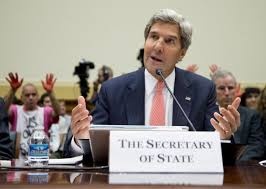
 ‘n Amerikaanse Senaatskomitee oor buitelandse betrekkinge het ‘n resolusie aanvaar ten gunste van militêre ingryping in Sirië, in weerwil van groot teenkanting wat onder gewone kiesers heers.
Tien senatore het ten gunste van die resolusie gestem, sewe daarteen en een het aangedui dat hy “teenwoordig” is.
Die Senaat, wat deur die Demokrate beheer word, sal later dié week oor direkte Amerikaanse militêre betrokkenheid in Sirië stem. Die VSA steun reeds Al-Kaida-vegters wat die Siriese president probeer ontsetel.
Die huis van verteenwoordigers wat onder Republikeinse beheer is, moet ook oor die maatreël stem alvorens pres. Barack Obama dit kan bekragtig. Die meeste Republikeine is daarteen gekant. Dit word slegs deur Neo-Konserwatiewes ondersteun wat nou betrokke is by die industriële en militêre kompleks.
Obama het die kongres gevra om goedkeuring te gee vir oënskynlik beperkte aanvalle op Sirië, in reaksie op president Bashar al-Assad se vermeende gebruik van chemiese wapens teen burgerlikes. Kritici meen egter dat die goedkeuring die president se magte veel verder sal uitbrei.
Daarbenewens is sommiges skepties oor die getuienis wat deur die Obama-administrasie voorgehou word vir die gebruik van gifgas, aangesien John Kerry foto’s van Irak gebruik het om die aantal sterftes in Sirië aan te dik. Die foto is terugetrek.
Intussen het ‘n voormalige Britse ambassadeur, Craig Murray, te kenne gegee dat Britse intelligensie geen aanduiding van Sirië se betrokkenheid by die gifgasaanval kon vind nie. Murray het sy verbasing daaroor uitgespreek en gesê die inligting is deur Israel aan die VSA verskaf wat nie dieselfde insamelingskapasiteit het as die VK se Troodos-fasiliteit wat die Midde-Ooste betref nie.
Mag satan se broers, olibama en kerriekop, hulle vasloop in n muur van geregtigheid wat hulle nie kan hanteer nie.
Die midde ooste gaan brand en dit gaan uiters nadelige gevolge he vir die res van die wereld, praat nie eers van die onskuldige mense wat die ewigheid in gebom gaan word a.g.v. die kortsigtigheid van die elite.
Mag elke lewe wat julle gaan neem julle ry tot in EWIGHEID.
nee wat kerrie het dieselfde in vietnam gedoen en ‘n hele rits purple hearts gekry vir die oortredings agv sy groot patriotisme van geneefse konvensie reëls wat hyself uiteensit in sy boek. al die ander in sy groep het ook onthou het wat regtig gebeur het. hy is met die joodse heinz van blikboontjies-faam getroud. die jode prys mos so hulle eie menseslagtings as heldedade. jammer die afrikaners is onder die slagoffers. hulle sal dit nie vergeet nie
Tien oorlogsugtige Amerikaanse senatore besluit vir ‘n hele paar miljoen burgers. Hulle ruik seker al daardie olie.
Politiek is so ‘n klugspul. Hier gaan dit nog erger.
Pro-Israel
groups mix Iran into Syria debate
By Jim Lobe
WASHINGTON – With the US Congress still deliberating over Barack Obama’s
request for authorization to take military action against Syria, the powerful
Israel lobby here has taken the lead in pressing the president’s case.
But in addition to echoing the administration’s view that Damascus’ alleged
violations of international norms against the use of chemical weapons must be
punished, pro-Israel groups are focusing their appeals at least as much, if not
more, on stopping what they say is Iran’s nuclear-weapons program.
“The Syria issue needs to be largely understood through the context of
Iran,” said Michael Makovsky, the director of the Jewish Institute for
National Security Affairs (JINSA), as he unveiled his organizations’s latest
report, “Strategy to Prevent a Nuclear Iran”, here on Wednesday.
“Stopping a nuclear-capable Iran is the gravest, most pressing national
security threat facing the United States today,” he added, quoting from
the introduction of the report, the product of a task force that included
several former George W Bush administration officials, several retired flag
officers, and Ambassador Dennis Ross, who served as Obama’s top adviser on Iran
for most of his first term.
“(I)f there isn’t a [congressional] response to the crossing of the red
line [against the use of chemical weapons], the Iranians will draw the lesson
that when we create red lines, we don’t mean it,” Ross said.
“So when the administration makes it clear that prevention [of Iran’s
acquisition of a nuclear weapon] is the objective, [the failure to act on
Syria] will make it look more rhetorical than real,” according to Ross,
who currently serves as counselor to the Washington Institute for Near East
Policy (WINEP), a pro-Israel think tank.
“So, I think there’s a direct relationship between what’s going on on
Syria and how the Iranians would perceive it.”
Those warnings came as the administration appeared to make progress on Capitol
Hill on Wednesday in rallying congress behind military action.
In a 10-7 vote, the Senate Foreign Relations Committee approved a resolution
authorizing Obama to conduct military strikes against Syria. Two Democrats and
five Republicans, including presidential hopefuls Marco Rubio and Rand Paul,
opposed the resolution. Another Democrat abstained.
To rally a majority, the resolution’s authors limited the authorization to 60
days – with a possible 30-day extension – and banned the use of ground forces
in Syria “for the purpose of combat operations”.
But they also appeased hawkish forces, led by Republican Senator John McCain,
by adding a statement that any action should aim to “change the momentum
on the battlefield” in favor of the rebels in order to enhance the chances
of a negotiated settlement to the two-year-old civil war. The resolution, which
will go to the floor next week, also urged an increase in US military aid to the
rebels.
The draft resolution submitted by the White House had called for a
“limited” action to prevent the use or proliferation of chemical
weapons in Syria.
While some administration officials initially predicted a campaign of only two
or three days of cruise-missile strikes that would not necessarily affect the
current balance of power in the war, stronger action now appears more likely
unless the Republican-led House of Representatives votes no or places more
limits on its version of the authorization when it meets next week.
The administration’s efforts to gain authorization have been significantly
bolstered by the Israel lobby which, until Tuesday, had maintained a public
silence on the issue. However, some of its more important institutions had been
quietly pressing both the administration and lawmakers for a more aggressive
policy toward Damascus for weeks, even before the alleged August 21 chemical
attack that killed more than 1,400 people, according to the White House.
On Tuesday, the American Israel Public Affairs Committee (AIPAC), the lobby’s
most powerful group, came out strongly in support of the authorization, as did
the Conference of Presidents of American Jewish Organizations and the
Anti-Defamation League.
They were followed by, among others, the Republican Jewish Coalition (RJC), a
group dominated by strongly anti-Obama wealthy donors who have provided
millions of dollars to Republican campaigns and are closely associated with
Israeli Prime Minister Benjamin Netanyahu and his Likud Party.
While most of the group echoed the administration’s position that the use of
chemical weapons must be punished, they also stressed that Washington’s
credibility regarding its enforcement of “red lines” was at stake,
particularly with respect to Iran.
“This critical decision comes at a time when Iran is racing toward
obtaining nuclear capability,” AIPAC stressed in its endorsement.
“Failure to approve this resolution would weaken our country’s credibility
to prevent the use and proliferation of unconventional weapons and thereby
greatly endanger our country’s security and interests and those of our regional
allies.”
That was very much the message conveyed by the new JINSA report and its two
co-chairs, Ross and Bush’s former undersecretary of defense for policy, Eric
Edelman, among other task force members present for the report’s release.
“I do think it’s important … for the credibility of the president’s
statements [to prevent Iran from obtaining a nuclear weapon] with regard to
Iran that the Congress authorize the use of force,” Edelman said.
“Unless Iran believes there is a credible military option underpinning the
willingness to negotiate, there will not be a successful negotiation,” he
added in reference to the so-called P5+1 (the US, Britain, France, China,
Russia plus Germany) talks with Iran that are considered likely to resume later
this month.
JINSA’s task force consists largely of members of a previous task force that
issued a series of very hawkish reports on Iran for the Bipartisan Policy
Center (BPC) over the past five years.
It said Washington’s explicit policy objective should be “to render Iran
unable to develop a nuclear weapons capability”, which it defined as the
point at which Iran could “manufacture fissile material for a nuclear
device in less time than would be required to detect and respond to such
activity”. According to some experts, that threshold is likely to be reached
by mid-2014.
With the election of Hassan Rouhani as Iran’s president, it said, Washington
should “try to make diplomacy work”, although the task force failed to
reach agreement on what terms would be acceptable.
While some members of the task force, including Ross, said the US should offer
a deal that would permit Iran to enrich uranium up to five percent and limit
its stockpile of enriched uranium subject to a strict inspections regime,
others said Iran should not be permitted any enrichment capability.
In the meantime, the task force argued against recent calls by think tanks and
Iran experts for Washington to make goodwill gestures, such as recognizing
Iran’s right to enrich or “preemptively signal a willingness to lift
sanctions during talks”.
On the contrary, the report urges increasing the pressure on Iran by imposing
new sanctions and preparing and developing “a very real military strike
capability against Iran’s nuclear and strategic facilities, and an array of
opportunities for pursuing political warfare against the Iranian regime”.
With respect to the former, Ross suggested “we should have a demonstration
[of a 30,000-pound ‘bunker-buster bomb’], put it on YouTube, let it go viral,
let the Iranians see it; this is a capability that was developed basically to
deal with them … ”
“I still think at this point, given where we are in Syria, the most
important thing right now is to act on the resolution and do it in a way that
is seen as being effective and meaningful and serious,” he added.
“Die VSA steun reeds Al-Kaida-vegters wat die Siriese president probeer ontsetel.”