
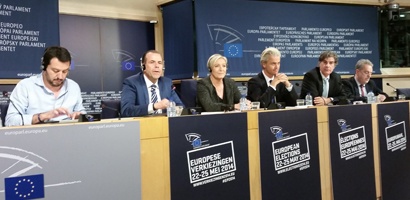

Gister het ‘n belangrike perskonferensie in die Europese Parlement te Straatsburg, Frankryk, plaasgevind waartydens vyf regse partye uit vyf lande die vrae van joernaliste beantwoord het. Die leidende figuur tydens die konferensie was Madame Marine Le Pen van die Front National wat alle vrae op Frans beantwoord het, terwyl Geert Wilders van die Nederlandse PVV verkies het om Engels te praat. (Sien volledige video hier onder.) Die Italiaanse en Oostenrykse verteenwoordigers het onderskeidelik Italiaans en Duits gepraat terwyl die voorsitter van die Vlaams Belang vrae op Nederlands beantwoord het.
Die vyf partye uit vyf lande behoort aan die “Europese Alliansie vir Vryheid”. Op die webblad van die Alliansie word die Alliansie só beskryf:
Die Europese Alliansie vir Vryheid (EAV) is ‘n pan-Europese allianse van Lede van die Europese Parlement, tesame met nasionale en streeksparlemtariërs en partye, wat onder ‘n politieke platform verenig is wat nasionale vryheid en demokrasie voorstaan in teenstelling met gesentraliseerde, supranasionale beheer.
Die EAV is een van elf “Europese partye op ‘n Europese vlak” en word gedeeltelik deur die Europese Parlement befonds.
Die party hou hom besig met kwessies aangaande vryheid en demokrasie in die EU en die EAV is nie werksaam binne ‘n Links-Regs- politieke paradigma nie terwyl sy lede vanuit ‘n wye politieke spektrum afkomstig is. Op die nasionale vlak, daarom, onderskryf EAV-lede nie noodwendig die politiek en oortuigings van ander lede van die Alliansie nie.
Die EAV kort nog twee lande en twee ander partye vir ‘n minimum van sewe om as groepering binne die Europese Parlement erken te word. Gister was die Sweedse Demokrate, wat ook as potensiële lid van die Alliansie genoem word, by die perskonferensie afwesig.
Volgens Marine Le Pen bestaan daar “verskille” tussen die Alliansie en die Hongaarse nasionalistiese party, Jobbik, sodat dié party nie in hul geledere toelaatbaar is nie. Dít het sy geantwoord op ‘n vraag van ‘n Hongaarse joernaliste in die saal.
Dieselfde joernaliste het aan haar gevra of die Alliansie nie bloot Eurofobies maar “Russofiel” is nie en daarom die Europese Unie ondergeskik aan Russiese belange wil stel nie. Hierop het Marine Le Pen geantwoord dat dit “dom” (stupide op Frans) van die Europese Unie is om ‘n anti-Russiese standpunt oor byvoorbeeld die Oekraïne in te neem, asook om Rusland “in die arms van China te dryf”. Wat haar betref, behoort Frankryk “goeie verhoudings met alle groot lande (grands pays) na te streef, waarvan Rusland ongetwyfeld een is”.
Hier is die video, in Frans, Engels, Nederlands, Duits en Italiaans.
Dit is mos nou goeie nuus. Skep sommer hope moed vir ons eie saak.
het zal niet verkeerd wezen Phillip als er nou spoedig nog eens, na de stemming vorig jaar op eerbaar initiatief van VB c.q. de weledele heer P. Claeys, door de gezamenlijke nieuwe krachten binnen de EU een veroordeling van het schrikbarende geweld als misdaad tegen de mensheid, jegens de etnische minderheid van Boere Afrikaners in SA wordt opgesteld. Er is namelijk nauw verband tussen een en ander en de situatie/vooruitzicht is er ter plekke bepaald nog niet beter op geworden. Met eraan verbonden concrete stappen ter verbetering van de benarde positie van deze onderdrukte bevolking.
De aarzeling samen te werken met enkele andere (te) rechtse partijen mag overboord gegooid gezien de voorliggende zware taken.
Dat bv. in Duitsland de ook door Gauck geschoffeerde NPD(Oma vor Sinti) als extreem rechts wordt afgeschilderd terwijl ‘Die Linke’ van Gysi nog steeds niet als extreem Linke doorgaan zegt voldoende! Het hele maatschappelijke politieke veld is ongezond verlinkst.
In ‘n vraag na die bevestiging van die opkoms van volksbewuste partye in
die afgelope verkiesing in Wes-Europa, skryf die Amerikaanse
politikus Patrick Buchanan oor wat al vroeër bestempel is as “die
krisis van die sagte bestuurstaat”. Die Europese Unie sou ‘n
voorbeeld van so ‘n sagte bestuurstaat wees.
Buchanan verwys na ‘n ongepubliseerde boek deur Sam Francis met die titel, “Leviathan and Its Enemies,” in die ontleding van die gebeure in Europa.
Oswald Spengler het die woord “Civilization” aangewend om die “terminale fase van ‘n kultuurorganisme” te bestempel. In 1941 het Pitirim Sorokin die eienskappe van ‘n Spengler se “Civilization” so
aangestip:
Kosmopolitanisme en die megapolis versus tuis,
ras, bloedverwantskap en vaderland; wentenskapsreligie of die
abstrakte, dooie metafisika in pleks van godsdiens uit die hart;
kille feitelikheid teenoor waardigheid en tradisie en eerbied vir die
ouere; internasionalistiese gemeenskaplike waardes; die menigte
teenoor die volk, seks teenoor moederskap… en meer..
Tussen die bestuurstaat, en die beskawing en die kultuur wat dit vooraf gegaan het, is die verskille skerp. Hierdie verskille is onmiskenbaar in die heersende botsings terwyl die Europese Unie van Jean Monnet en Robert Schumann hierdie onmiskenbare simptome van verval toon.
In ‘n mate is dit merkwaardig. Want onontkenbaar het die opkoms van die EU saamgeval met ‘n ongeëwenaarde toename in lewenstandaard vir honderde miljoene van die Atlantiese Oseaan tot die Oossee en van die Noord- tot die Middellandse See.
Egter,
hoewel Alfred Tennyson se “Parlement vir die Mens” en die
“Federasie van die Wêreld”die verbeelding aangegryp het van die
een-wêrelders van die 19- en 20ste eeu, is die droom bewys as
onvoldoende om die harte van Europese volke te verower. Wie sal tog sterf vir die Brusselse burokrasie?
Wat is die kenmerke van die populistiese partye wat in feitlik elke
Europese land opgeskiet het?
Eerstens is daar die verwerping van universalisme en transnasionalisme, en ‘n terugkeer tot patriotisme, sy liedere, simbole, vakansiesdae, gekiedenis, mites en legendes.
Hierdie sentiment word versinnebeeld, nie slegs in die skerp afkeer van nog integrasie in die EU nie, maar ‘n vyandigheid ten opsigte van nog
immigrasie uit die Derde – en Islam-wêreld of Oos-Europa.
Hierdie
volklere wil voortleef as die volke wat hulle is.
Selfs
die Switsers het in die vorige winter gestem vir ‘n poging van die
Volksparty waarvolgens kwotas ingestel word vir immigrante uit die
EU.
‘n
Tweede teken van die nuwe populisme is tradisionalisme en kulturele
konserwatisme, eerbied vir die godsdienstige en kultuurgeskiedenis en erfenis van die volk of inheemse stamme.
Daardie sege in die onlangse Eurovisie-wedstryd van Conchita, die bebaarde
tansvestiet wat in ‘n jurk opgetree het, wat, hoewel dit gevier is
deur vele in die Europese pers, het ‘n boodskap gestuur aan miljoene tradisionaliste dat dit nie langer hul kultuur kan wees nie.
Nog
‘n aspek betreffende die opkomende populistiese regse, soos aangestip deur die New York Times, is ‘n jaloerse bewondering vir Rusland se Wladimir Poetin.
Waarom?
Poetin verwerp nie slegs openlik die sedelike relativisme van die
Weste nie, onder sy leiding word Russiese wetgewing bewustelik
gewortel in die Christelike opvattings van reg en verkeerd.
Poetin is anti-Obama, en beset die kultuur-sedelike lugleegte gelaat deur Amerika. Terwyl Amerika multikulturisme omarm en ook die sogenaamde LGBT-regte en vrugafdrywing op aanvraag, repudieer Poetin hierdie Hollywoodse “waardes”.
Toe die Weste se politici en nuusmedia hulle vasloop teen sy anneksasie van die Krim as ‘n oortreding van die Amerikaans-neergelegde Nuwe Wêreldorde-reëls, het Poetin patriotisme en nasionalisme ter verdediging aangevoer: die Krim het vir 200 jaar aan ons behoort. Die meeste van sy inwoners is Russe. Hulle wens is om terug te keer na Moeder Rusland. Ons warmwaterhawe is daar. Amerika skryf nie aan Rusland voor waar dit gaan oor Rusland se lewensbelangrike sake nie.
In die anti-Amerikaanse omgewing wat in Europa bestaan word dit
toegejuig.
Nog ‘n saak spook egter ook by Europa: sesessionisme: Skotte,
Katalane en Venisiërs soek onafhanklikheid en wil weer lande van
hule eie wees.
Wat die slegsêery van die populiste betref, dat hulle rassiste,
anti-Semities, homofobies en fasciste is, hierdie skeldtaal het weens
sy oomaat sy giftigheid verloor.
Die Eurokrate het te veel wolf geskreeu.
Hoe ernstig is hierdie regse populisme? Ten minste, soos die Tea Party die Amerikaanse Republikeinse Party regs gedwing het, sal hierdie partye waarskynlik die sentrum- en sentrumregse partye in hul rigting oral in Europa dwing.
Dan is daar die werklike bedreiging van nie slegs ‘n verbrokkeling van die EU nie, maar ook van Brittanje, die verlies van Skotland na 300 jaar, Engeland se sesessie van die EU, en die ineenstorting van die Torie-party tot Eurofiele en Eurofobe, alles ten tye van David
Cameron se wagbeurt.
Soos stofvergoding, verbruikerisme en sosialisme het transnasionalisme ‘n fatale hou uit dieselfde oord ontvang. Die liggaam word daardeur gevoed maar die siel ly honger. En uiteindelik hoor die verveelde mens weer die wekroepe van weleer.
Aldus Buchanan: vry vertaling
interessant.
“In die anti-Amerikaanse omgewing wat in Europa bestaan word dit toegejuig.”
De ‘bevrijder’ in en na WOII ontpopt zich in diverse opzichten niet alleen in de VS zelf al een tijd toenemend als ‘bezetter’ via o.m. de geheime dienst ingang en spionage van de burgers op alle terreinen. Zo zijn bv. de BND en MID e.v.a. tot loopjongen verworden voor hoofdzakelijk ondoorzichtig buitenlands belang en is Merkel en co. nogal terughoudend met stellingname op het punt van totale ‘Uberwachung’.
Het komt de geheime diensten in Europa wel uit nu en dan de NSA te kunnen aanwijzen 😉 (na bezorgde vragen uit eigen land)
Alles natuurlijk ten gunste van de arrogante gevestigde orde.
Ek aanvaar Bucahan se bedoeling is dat daar benewens ‘n pro-Amerikaanse omgewing ook ‘n anti-Amerikaanse omgewing bestaan in Wes-Europa, die pro-Amerikaanse omgewing gevoed deur die Amerikaanse inligtingsdienste, uiteraard. Hoe omvangryk hierdie “voeding” is sal sekerlik die kop laat duisel. Angela Merkel, met die skop waarmee Helmuth Kohl haar destyds aangehelp het, lyk vir my as waarnemer hier uit verre Suid-Afrika maar duister.
de wederom ‘machtigste vrouw ter wereld’, die typerend als beroepsburaucraat nog nooit echt gewerkt heeft, wil zoals bekend graag Ban Ki Moon vervangen. Daarvoor zal er nog wel een paar miljoen ‘vluchtelingen’ worden toegelaten. Opvallend hoe het CDU(Dld) nationaal vast in het zadel blijft en bv. het CDA(Ned) gedecimeerd is.
En nou lyk dit of ‘n ander vrou, Marinne le Pen, uit die Franse mis aangegalop kom om vir Merkel uit te daag.
Wonder so terloops wanneer laas het ‘n verwikkeling in die Franse politiek (hoewel nie slegs Franse politiek nie), soveel ingehou vir ons hier. In die tyd van Napoleon en toe die Kaap ‘n Bataafse republiek geword het? Wie weet, dalk hoor ons een van die dae weer minuette en allegrettos in die Kasteel in Kaapstad opklink, die pandoere wat nou die fort daar hou, wat die hasepad gekies het.
Fantasties. Wat n uitmuntende stuk kommentaar. Dankie gas. Ek is dieen wat gewekdig baat gevind het hierby.
Dankie vir die waardering.
die ‘onbekende persoon’ is Marcel de Graaff. (europese lijsttrekker PVV)
http://www.elsevier.nl/Politiek/nieuws/2014/3/Marcel-de-Graaff-wordt-lijsttrekker-PVV-in-Europa-1488402W/
Dis alles baie bemoedigend. Marine Le Pen is hoopvol om haar geoepering te vorm, maar vir die oomblik is dit nog nie ‘n uitgemaakte saak nie. Sy het reeds genoeg stemme maar nog nie genoeg lande nie. (Moet sewe wees en sy het sover vyf). Die klip in die skoen is veral Nigel Farage en sy UKIP party wat nog nie kans sien vir die Front National nie weens, wat ‘n mens kan beskryf as die “muishond wil nie met brakhond gesien word nie”-sindroom. Farage beskou die FN en Marine Le Pen as te “rassisties” en “anti-semities” vir hom, foeitog.
Nog ‘n klip in die skoen is natuurlik Marine Le Pen self wat te goed is vir die Hongaarse JOBBIK-party, vir dieselfde rede van “die muishond wil nie met die brakhond gesien wees nie”.
Die Engelse het ‘n manier om sommer die “baas” van ‘n Organisasie te wil wees, en dan te wil hiet en gebiet.
Ek stem met die Franse saam dat hulle maar versigtig vir dieBritte moet wees.
Engeland het nog nie genoeg geleer nie. Laat hulle eers nog ‘n klompie wonde opdoen, en ‘n bietjie meer bloei.
Jy moet onthou dat die engelse altyd Maar altyd twee kante speel. Farage is waarskynlik net ‘n pion deur MI5 geborg.
Dr Dan met hulle volgende vergadering moet jy ons Afrikaner en ons FN Party
verteenwoordig – jy het nie eers oorfoontjies nodig nie jy kan feitlik al die
tale praat.
de heer Roodt zal zeker doordrongen zijn van de noodzaak tot een spoedig bezoek aan Parijs Riempies. Nou niet met studiedoeleinden in de Rue des Ecoles(Saint Germain ?) maar de dagelijkse onderdrukking in SA van de Boere Afrikaner onder de aandacht brengend. In combinatie met het aandoen van verscheidende adressen in Nederland en Vlaanderen. Of alledrie ineen in bv. Brussel !
Goeiedag Hans – Dr. Dan het so n paar jaar terug heelwat
vriende gemaak in die buiteland waaroor hy gerapporteer het op Praag.
Ek glo dat die buiteland begin wakkerskrik oor die vergrype
en dikriminasie en self moorde teen die blankes hier onder die swart regering.
Dit wil vir my voorkom of die woord “rassisme” besig is om heeltemal sy tref krag verloor het en self besig is om die sy werklike betekenis terug te wen. In die media onderhoude was daar net een beriggewer wat die woord gebruik het en die misnoee van sy mede beriggewers op die hals gehaal het. Ek dink ook soos jy dat hoe gouer dr. Dan die groep gaan besoek en met hulle ingesprek tree vir ons – hoe beter. Smee die yster terwyl die vuur warm is.
Welkom terug Riempies ! Hoop ons sal mekaar van nou af beter kan verdra op die forums.
Dankie Leana – ek het n tydjie nodig gehad om te desensiteer
en tot verhaal te kom – daar was darrem baie lelike leuens oor my versprei en hoe verweer n mens jou daarteen en hoe stel n mens dit reg? Ek weet nou nog nie wat die sneller vir hierdie aanval uit die bloute op my was nie. Ek het dit egter agter my geplaas.
Bly om te hoor jy het dit agter jou geplaas Riempies. Alles was eintlik so onnodig. Mag ek dan nou ook hierdie geleentheid gebruik om vir jou om verskoning te vra vir my geveinsde woorde ? Kan net se ek is jammer.
Mooiso, dit vat n man/vrou op n perd om dit te doen. Dis onse mense daardie.
Dankie Leana dit is werklik grootmoedig van jou. Ek het dit agter my geplaas.
James Pertras op Global Research:The European parliamentary elections witnessed a major breakthrough for the right-wing parties throughout the region. The rise of the Right runs from the Nordic countries, the United Kingdom, the Baltic and Low countries, France, Central and Eastern Europe to the Mediterranean.
Most, if not all, of these emerging right-wing parties mark a sharp break with the ruling neo-liberal, Christian and Social Democratic parties who have presided over a decade of crisis.
The ‘new Right’ cannot be understood simply by attaching negative labels (‘fascist’, ‘racist’ and ‘anti-Semitic’). The rise of the Right has to be placed in the context of the decay of political, social and economic institutions, the general and persistent decline of living standards and the disintegration of community bonds and class solidarity. The entire existing political edifice constructed by the neo-liberal parties bears deep responsibility for the systemic crisis and decay of everyday life. Moreover, this is how it is understood by a growing mass of working people who vote for the Right.
The so-called ‘radical Left’, usually defined as the political parties to the left of the governing Social Democratic parties, with the exception of SYRIZA in Greece, have failed to capitalize on the decline of the neo-liberal parties. There are several reasons that account for the lack of a right-left polarization. Most of the ‘radical Left’, in the final account, gave ‘critical support’ to one or another of the Labor or Social Democratic parties and reduced their ‘distance’ from the political-economic disasters that have followed. Secondly, the ‘radical Left’s’ positions on some issues were irrelevant or offensive to many workers: namely, gay marriage and identity politics. Thirdly, the radical Left recruited prominent personalities from the discredited Labor and Social Democratic parties and thus raised suspicion that they are a ‘new version’ of past deceptions. Fourthly, the radical Left is strong on public demonstrations demanding ‘structural changes’ but lacks the ‘grass roots’ clientelistic organizations of the Right, which provide ‘services’, such as soup kitchens and clinics dealing with day-to-day problems.
While the Right pretends to be ‘outside’ the neo-liberal establishment challenging the assumption of broad powers by the Brussels elite, the Left is ambiguous: Its support for a ‘social Europe’ implies a commitment to reform a discredited and moribund structure. The Right proposes ‘national capitalism’ outside of Brussels; the Left proposes ‘socialism within the European Union’. The Left parties, the older Communist parties and more recent groupings, like Syriza in Greece, have had mixed results. The former have generally stagnated or lost support despite the systemic crisis. The latter, like Syriza, have made impressive gains but failed to break the 30% barrier. Both lack electoral allies. As a result, the immediate challenge to the neo-liberal status quo comes from the electoralnew Right parties and on the left from the extra-parliamentary social movements and trade unions. In the immediate period, the crisis of the European Union is being played out between the neo-liberal establishment and the ‘new Right’.
The Nature of the New Right
The ‘new Right’ has gained support largely because it has denounced the four pillars of the neo-liberal establishment: globalization, foreign financial control, executive rule by fiat (the Brussels troika) and the unregulated influx of cheap immigrant labor.
Nationalism, as embraced by the new Right, is tied to national capitalism: Local producers, retailers and farmers are counterpoised to free traders, mergers and acquisitions by international bankers and the giant multinationals. The ‘new Right’ has its audience among the provincial and small town business elite as well as workers devastated by plant closures and relocations.
The ‘new Right’s’ nationalism is ‘protectionist’ – seeking tariff barriers and state regulations to protect industries and workers from ‘unfair’ competition from overseas conglomerates and low-wage immigrant labor.
The problem is that protectionism limits the imports of cheap consumer goods sold in many small retail shops and affordable to workers and the lower middle class. The Right ‘dreams’ of a corporatist model where national workers and industries bond to oppose liberal competitive capitalism and class struggle trade unions. As the class struggle declines, the ‘tri partite’ politics of the neo-liberal right is reconfigured by the New Right to include ‘national’ capital and a ‘paternalistic state’.
In sum, the nationalism of the Right evokes a mythical past of harmony where national capital and labor unite under a common communal identity to confront big foreign capital and cheap immigrant labor.
Political Strategy: Electoral and Extra-Parliamentary Politics
Currently, the new Right is primarily oriented to electoral politics, especially as it gains mass support. They have increased their share of the electorate by combining mass mobilization and community organizing with electoral politics, especially in depressed areas. They have attracted middle class voters from the neo-liberal right and working class voters from the old Left. While some sectors of the Right, like the Golden Dawn in Greece, openly flaunt fascist symbols – flags and uniforms – as well as provoking street brawls, others pressure the governing neo-liberal right to adopt some of their demands especially regarding immigration and the ‘deportation of illegals’. For the present, most of the new Right’s focus is on advancing its agenda and gaining supporters through aggressive appeals within the constitutional order and by keeping the more violent sectors under control. Moreover, the current political climate is not conducive to open extra-parliamentary ‘street fighting’ where the new Right would be easily crushed. Most right-wing strategists believe the current context is conducive to the accumulation of forces via peaceful methods.
Conditions Facilitating the Growth of the Right
There are several structural factors contributing to the growth of the new Right in Europe:
First and foremost, there is a clear decline of democratic power and institutions resulting from the centralization of executive – legislative power in the hands of a self-appointed elite in Brussels. The new Right argues effectively that the European Union has become a profoundly authoritarian political institution disenfranchising voters and imposing harsh austerity programs without a popular mandate.
Secondly, national interests have been subordinated to benefit the financial elite identified as responsible for the harsh policies that have undermined living standards and devastated local industries. The new Right counterpoises ‘the nation’ to the Brussels ‘Troika’ – the International Monetary Fund, the European Central Bank and the European Commission.
Thirdly, ‘liberalization’ has eroded local industries and undermined communities and protective labor legislation. The Right denounces liberal immigration policies, which permit the large-scale inflow of cheap workers at a time of depression level unemployment. The crisis of capitalism combined with the large force of cheap immigrant labor forms the material basis for right-wing appeals to workers, especially those in precarious jobs or unemployed.
Right: Contradictions and the Double Discourse
The Right, while criticizing the neo-liberal state for unemployment, focuses mainly on the immigrants competing with nationals in the labor market rather than on the capitalists whose investment decisions determine levels of employment and unemployment.
The Right attacks the authoritarian nature of the European Union, but its own structures, ideology and history pre-figure a repressive state.
The Right rightly proposes to end foreign elite control of the economy, but its own vision of a ‘national state’, especially one linked to NATO, multi-national corporations and imperial wars, will provide no basis for ‘rebuilding the national economy’.
The Right speaks to the needs of the dispossessed and the need to ‘end austerity’ but it eschews the only effective mechanism for countering inequalities – class organization and class struggle. Its vision of the ‘collaboration between productive capital and labor’ is contradicted by the aggressive capitalist offensive to cut wages, social services, pensions and working conditions. The new Right targets immigrants as the cause of unemployment while obscuring the role of the capitalists who hire and fire, invest abroad, relocate firms and introduce technology to replace labor.
They focus the workers’ anger ‘downward’ against immigrants, instead of ‘upward’ toward the owners of the means of production, finance and distribution who ultimately manipulate the labor market.
In the meantime the radical Left’s mindless defense of unlimited immigration in the name of an abstract notion of ‘international workers solidarity’ exposes their arrogant liberal bias, as though they had never consulted real workers who have to compete with immigrants for scarce jobs under increasingly unfavorable conditions.
The radical Left, under the banner of ‘international solidarity’, has ignored the historical fact that ‘internationalism’ must be built on the strong national foundation of organized, employed workers.
The Left has allowed the new Right to exploit and manipulate powerful righteous nationalist causes. The radical Left has counterpoised ‘nationalism’ to socialism, rather than seeing them as intertwined, especially in the present context of an imperialist-dominated European Union.
The fight for national independence, the break-up of the European Union, is essential to the struggle for democracy and the deepening of the class struggle for jobs and social welfare. The class struggle is more powerful and effective on the familiar national terrain – rather than confronting distant overseers in Brussels.
The notion among many radical Left leaders to ‘remake’ the EU into a ‘Social Europe’, the idea that the EU could be converted into a ‘European Union of Socialist States’ simply prolongs the suffering of the workers and the subordination of nations to the non-elected bankers who run the EU. No one seriously believes that buying stocks in Deutsch Bank and joining its annual stockholders meetings would allow workers to ‘transform’ it into a ‘People’s Bank’. Yet the ‘Bank of the Banks’, the ‘Troika’, made up of the European Commission, the European Central Bank and the IMF, set all major policies for each member state of the European Union. Un-rectified and remaining captive of the ‘Euro-metaphysic’, the Left has abdicated its role in advancing the class struggle through the rebirth of the national struggle against the EU oligarchs.
Results and Perspectives
The Right is advancing rapidly, even if unevenly across Europe. Its support is not ephemeral but stable and cumulative at least in the medium run. The causes are ‘structural’ and result from the new Right’s ability to exploit the socio-economic crisis of the neo-liberal right governments and to denounce authoritarian and anti-national policies of the unelected EU oligarchy.
The new Right’s strength is in ‘opposition’. Their protests resonate while they are distant from the command centers of the capitalist economy and state.
Are they capable of moving from protest to power? Shared power with the neo-liberals will obviously dilute and disaggregate their current social base.
The contradictions will deepen as the new Right moves from positions of ‘opposition’ to sharing power with the neo-liberal Right. The massive roundups and deportation of immigrant workers is not going to change capitalist employment policies or restore social services or improve living standards. Promoting ‘national’ capital over foreign through some corporatist union of capital and labor will not reduce class conflict. It is totally unrealistic to imagine ‘national’ capital rejecting its foreign partners in the interest of labor.
The divisions within the ‘nationalist Right’, between the overtly fascist and electoral corporatist sectors, will intensify. The accommodation with ‘national’ capital, democratic procedures and social inequalities will likely open the door to a new wave of class conflict which will expose the sham radicalism of the ‘nationalist’ right. A committed Left, embedded in the national terrain, proud of its national and class traditions, and capable of unifying workers across ethnic and religious ‘identities’ can regain supporters and re-emerge as the real alternative to the two faces of the Right – the neo-liberal and the ‘nationalist’ new Right. The prolonged economic crisis, declining living standards, unemployment and personal insecurity propelling rise of the nationalist Right can also lead to the emergence of a Left deeply linked to national, class and community realities. The neo-liberals have no solutions to offer for the disasters and problems of their own making; the nationalists of the new Right have the wrong -reactionary – answer. Does the Left have the solution? Only by overthrowing the despotic imperial rule of Brussels can they begin to address the national-class issues.
In the absence of a Left alternative, the working class voters have opted for two alternatives: Massive voter abstention and strikes. In the recent EU election, 60% of the French electorate abstained, with abstention approaching 80% in working class neighborhoods. This pattern was repeated or even exceeded throughout the EU – hardly a mandate for the EU or for the ‘new Right’. In the weeks and days before the vote, workers took to the streets. There were massive strikes of civil servants and shipyard workers, as well as workers from other sectors and mass demonstrations by the unemployed and popular classes opposing EU-imposed ‘austerity’ cuts in social services, health, education, pensions, factory closures and mass lay-offs. Widespread voter abstention and street demonstrations point to a huge proportion of the population rejecting both the neo-Liberal Right of the ‘Troika’ as well as the ‘new Right’.
Gas ek kon voel hoe meer ek lees – hoe meer opgewonde raak
ek. Dit is presies soos ek dit sien – kort net die vermoe om dit so kronologies en raak te vat.
Gas wil jy dit nie oorweeg om hierdie skrywe vir ons redaktrisie aan te bied en vra om dit te vertaal in Afrikaans en as rubriek aan te bied? Dit is n moet lees vir almal wat die nuwe globale politieke strominge
wil verstaan, trouens meer – ons eie insig verbreed en te besef hoe belangrik ons eie bydra en deelname tot hierdie renaissance is.