
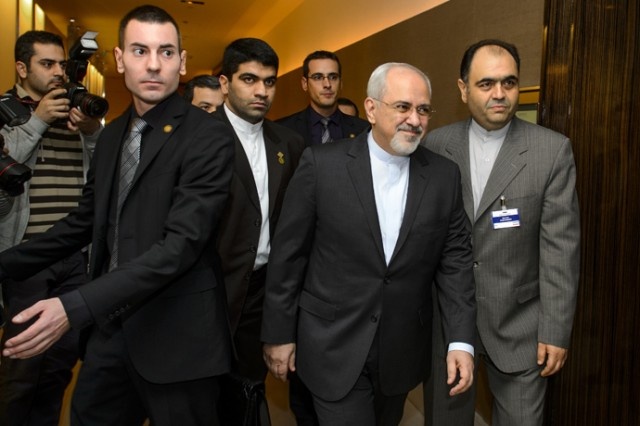
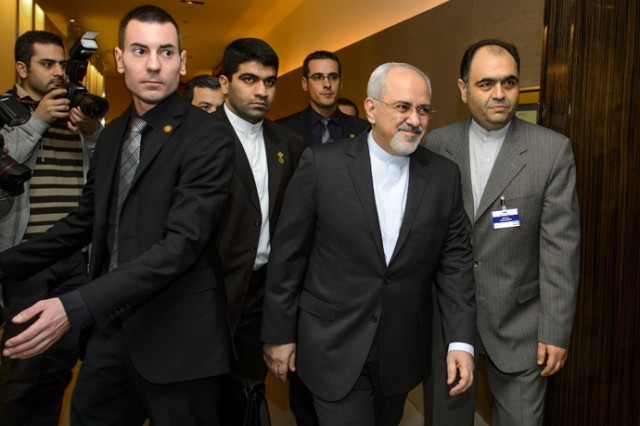
Iran en ses wêreldmoondhede het ‘n ooreenkoms bereik oor Teheran se omstrede kernprogram, na vyf dae van intensiewe onderhandelinge in Geneve in Switserland.
Die doel van die samesprekings was om ‘n tussentydse ooreenkoms vir ses maande op te stel, om alle partye tyd te gee om te onderhandel vir ‘n volledige skikking.
Israel het die verwikkeling skerp gekritiseer.
Volgens die ooreenkoms sal Iran sy kern-aktiwiteite verminder in ruil vir beperkte en geleidelike vermindering van sanksies. – RSG
Prince Alwaleed bin Talal: An Ally Frets About American Retreat
Influential Saudi royal Prince Alwaleed bin
Talal talks about the U.S. debacle in Syria, the Iranian threat, and
‘this perception that America is going down.’
Email
Print
Save
↓ More
511 Comments
Facebook
Twitter
LinkedIn
smaller
Larger
By
Matthew Kaminski
connect
Nov. 22, 2013 7:18 p.m. ET
‘The U.S. has to have a foreign policy.
Well-defined, well-structured. You don’t have it right now,
unfortunately. It’s just complete chaos. Confusion. No policy. I mean,
we feel it. We sense it, you know.”
Members
of the Saudi royal family have voiced their displeasure with the
Obama
administration’s approach to the Middle East through private
channels and recently in public as well. None of them puts it quite like
HRH
Prince Alwaleed bin Talal bin Abdulaziz Alsaud.
One of some three-dozen living
grandsons of the first Saudi King Abdulaziz, this prince is a prominent
but atypical royal. His investment company made him the Arab world’s
richest businessman. He strikes a modern image for a Saudi, employing
female aides and jet-setting on a private
Boeing
BA +2.29%
747. He’s at ease with Western media.
Passing
through New York earlier this week,
Mr. Alwaleed,
who is 58, sits down with the Journal editorial board between a
couple of television appearances. He wears a blue suit, shirt and tie.
These days, his bouffant widow’s peak has more salt than pepper. The
prince holds no important government post in Saudi Arabia, but it’s hard
to shake the impression that here is the uncensored id of the reserved
House of
Saud.
“America is shooting itself in
the foot,” he says. “Saudi Arabia and me, myself, we love the United
States. But what’s happening right now here, from Republicans and
Democrats, is just not helping the image of the United States and is
making this perception that America is going down a reality.”
Enlarge Image
Neil Davies
Mr. Alwaleed struggles to understand
how a wing of the GOP can shut down the government and threaten a debt
default. His company has a significant economic bet on the U.S. through
Twitter
TWTR -2.52%
and New York’s Plaza Hotel, among many holdings. As for President
Obama, his second term is “going downhill completely,” he says, adding
on several occasions the disclaimer that “this is the impression I have
in Saudi Arabia.” But it’s clear that the Saudis believe that the
president’s political troubles shape his actions in their region.
Mr.
Obama’s recent Hamlet act on Syria surprised and infuriated Riyadh.
After the worst chemical-weapons atrocity of the war, the American
leader heeded long-standing calls for military intervention, then hedged
by asking for congressional approval, then nixed airstrikes in favor of
a disarmament pact with Syria’s
Bashar Assad.
The civil war continued—with Assad and his Iranian allies lately
taking the upper hand. Mr. Alwaleed says of Mr. Obama: “He blinked.”
Then
came the autumn outreach to Iran’s new president,
Hasan Rouhani,
leading to this week’s negotiations in Geneva on Iran’s nuclear
program. Another “impression” from the prince: President Obama’s falling
popularity explains his “overeagerness” for an agreement made “very
fast to at least put one issue in foreign policy aside” because “he’s
wounded now across the board.” The Saudis view the Shiite theocracy in
Tehran as the biggest threat to the Sunni Arab world.
Though
the American public soured on Saudi Arabia after the 9/11 terror
attacks were organized by a Saudi, Washington and Riyadh remained on
good terms. But now relations are strained, perhaps the worst breach
since the 1980s fight over the proposed sale of U.S. Awacs planes to the
kingdom. A frequent Saudi complaint these days is that this White House
doesn’t listen to them or reveal its true intentions.
“Frankly
speaking,” Mr. Alwaleed says, during the first Obama term “his
communication was almost nil,” aside from a brief visit with
King Abdullah
in Riyadh in 2009.
Ronald Reagan
and every president since cultivated personal ties, but “Obama is
very cold because he is very, very immersed” in domestic policy.
Hillary Clinton,
who logged 956,733 air miles in four years at the State
Department, came to Saudi Arabia once. “She was not really tackling the
Middle East,” the prince says. In less than a year at Foggy Bottom,
John Kerry
has called on the Saudis three times, and the
royals
appreciate his engagement.
The
deal on offer in Geneva this week relaxes sanctions on Iran in exchange
for promises to slow work on parts of the nuclear program. The Saudis
and Israelis have both pre-emptively condemned any agreement that
doesn’t dismantle Iran’s ability to enrich uranium and build a bomb.
This one won’t. Mr. Alwaleed says the Saudis are trying to “put maximum
pressure now on the United States not to succumb to the president of
Iran’s soft talk.”
He endorses Israeli
Prime Minister
Benjamin Netanyahu’s
line to describe Mr. Rouhani: “a wolf in sheep’s clothing.” He
notes this startling alliance of Wahhabist Saudi Arabia, custodian of
Islam’s holiest sites, and the Jewish state. “For the first time, Saudi
Arabian interests and Israel are almost parallel,” he says, his voice
rising. “It’s incredible.”
The prince
stops short of endorsing an Israeli military strike on Iran, but in the
same breath says he thinks a military option to “neutralize” Iran’s
nuclear potential is preferable to a bad diplomatic deal.
If
Iran does go nuclear, Saudi Arabia may not be far behind. It has
options. Riyadh underwrote Pakistan’s atomic-bomb program and keeps the
country’s economy afloat with its largess. The “arrangement with
Pakistan is too strong” to dismiss an almost overnight nuclearization of
the Arab peninsula with their help, Mr. Alwaleed suggests. Pakistani
Prime Minister
Nawaz Sharif,
who returned to power in June, lived in Saudi exile after a 1999
military coup. “Nawaz Sharif, specifically, is very much Saudi Arabia’s
man in Pakistan,” Mr. Alwaleed says.
The
Obama administration’s disengagement from the Middle East was implicit
in the withdrawal of all U.S. troops from Iraq and the refusal to arm
Syria’s rebels. Susan Rice, the national security adviser, was explicit
last month in an interview with the
New York Times
NYT +0.65%
that the White House had adopted a new policy to scale back
America’s involvement: “We can’t just be consumed 24/7 by one region,
important as it is.”
As the U.S.
distanced itself from Egypt after July’s military coup, Russia has
offered Cairo arms and support. The Chinese are in no position or mood
to take the baton of regional enforcer from the U.S., which polices the
Strait of Hormuz to keep it open for oil tankers and protects friendly
Gulf states. But the Saudis are getting along better by the day with
Beijing, says Mr. Alwaleed, adding that “China is very eager to fill any
vacuum that the United States may create.” Bluff, threat or prediction?
Check back in a few years.
Another
feature of the Obama era is the regional freelancing by countries that
previously deferred to Washington. Defying the U.S., the Saudis in 2011
sent soldiers over the causeway into Bahrain to protect the island’s
Sunni king from street demonstrations by members of the Shiite majority
pressing for greater political rights. The Saudi royals also blamed
Washington for abandoning an old American friend in Egypt’s President
Hosni Mubarak,
who was deposed in February 2011. For the record, Mr. Alwaleed thinks the Mubarak presidency was unsalvageable.
From
the start of the Syrian conflict, Saudi and Qatari support flowed to
the anti-Assad rebels. Mr. Obama held back before permitting small-arms
deliveries in recent months. But Assad’s chemical attacks and an
emergency lifeline of Iranian fighters, money and arms have turned the
tide of the war. Mr. Alwaleed says Riyadh has upped its weapons supplies
and training for the rebels but can’t do as much as a superpower.
As
the West stood aside, extremist factions in the rebel coalition
strengthened and turned on each other. Some are linked to al Qaeda,
“really savages, like in Afghanistan,” says Mr. Alwaleed. Of course,
Gulf money and weapons also went to them, as it goes to their brethren
in Afghanistan and Pakistan today—but that’s left unsaid.
Mr.
Alwaleed believes that Washington has now decided to keep Assad in
place at least long enough to surrender his chemical weapons stockpile.
“The U.S. policy is to have the devil you know,” he says. “Saudi policy
is to have any devil in Syria other than the devil you know.”
Educated
in the U.S., Mr. Alwaleed has said he started off in 1979 with a
$30,000 loan from his father to create Kingdom Holding Co., a
diversified-investment firm. The prince denies persistent rumors that
the company is an investment front for other Saudi royals who guard
their anonymity.
Mr. Alwaleed came to
business prominence in the U.S. with a $590 million cash infusion into
Citicorp in 1991. Later that decade, he took a 5% stake in
News Corp.
NWSA -0.06%
that is now 7%. He’s the third-largest shareholder in the company that publishes The Wall Street Journal.
When
Forbes this spring put him 26th on its annual list of the world’s
richest, with a fortune estimated at $20 billion, Mr. Alwaleed said the
magazine shortchanged him, and he threatened to sue. He visibly relishes
the perks of princely billionairehood.
Some
false steps have hurt his reputation. Days after 9/11, Mr. Alwaleed
donated $10 million to New York City accompanied by a statement that the
U.S. government “should re-examine its policies in the Middle East and
adopt a more balanced stance toward the Palestinian cause.” Mayor
Rudy Giuliani
returned the check.
The House of
Saud’s concern about the U.S. these days isn’t merely about foreign
policy. The American energy revolution is also a potential threat.
Driven by technological advances in shale exploration, the U.S. will
pass Saudi Arabia and Russia as the world’s top oil producer by 2015,
the International Energy Agency said this month. Mr. Alwaleed hasn’t
looked at possible investments in shale—at least “not yet.”
As
for the Saudis’ own bottom line: With America’s reliance on imported
oil declining, he warned his government a few months ago about the
kingdom’s unhealthy dependence on oil-export revenues. But Mr. Alwaleed
also says the world will always demand Saudi Arabia’s cheaply drilled
crude.
The political upheavals in
Tunisia and Egypt that began almost three years ago sent a tremble
through the House of Saud. King Abdullah, who turns 90 next year, moved
to head off discontent by pouring more than $130 billion into jobs and
housing for young Saudis. The strategy eased any pressure to open up the
absolutist monarchy. Mr. Alwaleed takes pains to mention his support
for reform and the gradual modernization of Saudi Arabia, including the
right of women to drive.
Concerns about
the health of King Abdullah and an uncertain succession hang heavy over
Saudi Arabia’s future. Mr. Alwaleed’s father sits on an Allegiance
Council created early in King Abdullah’s reign to formalize the
selection of monarchs. This new system, he repeats more than once, is
“untested.” Mr. Alwaleed’s mixed Lebanese heritage through his mother,
among other reasons, virtually rules him out from consideration.
America’s
current arm’s-length approach to the region presents an opening as well
as a danger for the Saudis. After July’s coup in Egypt, Riyadh gave the
new military-backed government $5 billion to tide the country’s economy
over for a few months. The rise of Egypt’s Muslim Brotherhood and
demands for popular democracy were unwelcome in Riyadh. Mr. Alwaleed
notes that Saudi diplomacy also carries a fat checkbook in Jordan,
Palestine and Yemen, which are in his words “under our hegemony.”
“If
you look at a map of the Arab world now, Saudi Arabia is very much the
leader,” says the prince. “America cannot afford to have the leader of
the Arab world not be on the same wave length as the United States.”
Mr. Kaminski
is a member of the Journal’s editorial board.