
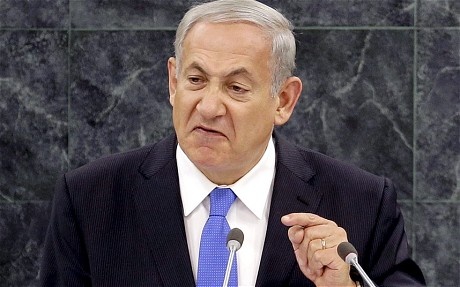

Die Israelse eerste minister Benjamin Netanyahu het tydens sy toespraak by die sitting van die VN se Algemene Vergadering ‘n waarskuwing gerig teen die regering van Iran.
Hy het die nuwe president Hassan Rouhani as ‘n “wolf in skaapsklere” bestempel en gesê Israel sal nooit ‘n Iranese kernprogram toelaat nie. Hy het gesê Iran is so gevaarlik soos 50 Noord-Koreas.
Westerse diplomate het egter Netanyahu se definisie van ‘n ooreenkoms met Iran as “heeltemal onrealisties” beskryf omdat dit ‘n “onvoorwaardelike oorgawe” vereis.
Iran se adjunk-ambassadeur by die VN, Khodadad Seifi het op sy beurt gesê Iran is ‘n ondertekenaar van die kern-sperverdrag. Israel wat self ‘n kernmoondheid is, is nie ‘n ondertekenaar van die verdrag nie.
Rouhani het vroeër ‘n fatwa, ‘n heilige beletsel, oor kernwapens uitgeroep. Hy het herhaal dat sy land geen planne het om kernwapens te ontwikkel nie. Verskeie Amerikaanse intelligensie-agentskappe het hom reeds gelyk gegee.
Sedert sy verkiesing het Rouhani reeds verskeie versoenende uitsprake teenoor Israel en die Weste gemaak.
Die moslem mag, volgens sy boek, n verdrag teken met enige “infidel” en dit verbreek wanneer dit hom pas. Nieteenstaande is die Israel landjie van Rotcshild, net so n groot bedreiging vir die wereld. Laaste telling was Israel se kernkoppe, op om en by 300
Saudie Arabie en Israel is altwee vies vir die Regeerder in die Withuis oor sy standpunt t.o.v. Iran
Niks kan meer geglo word in hierdie wêreld nie.Die hele lot lieg vir mekaar en tussen mekaar.
Ek dink ek gaan maar weg trek uit hierdie gemors uit.
http://www.youtube.com/watch?v=6LGlgAgjVBU
http://www.youtube.com/watch?v=lO08uoJcO1I
Netanyahu pours scorn on Rouhani
By Jim Lobe
WASHINGTON – Like the proverbial skunk at the garden party, Israeli Prime
Minister Benjamin Netanyahu used his turn at the podium at the UN General
Assembly on Tuesday to pour scorn on Iran’s new president, 96 hours after a
smiling Hassan Rouhani departed New York after a momentous four-day stay that
raised unprecedented hopes for detente with the United States and the West.
Echoing his early assessment of the Iranian leader, Netanyahu described Rouhani
as a “wolf in sheep’s clothing, a wolf who thinks he can pull the eyes –
the wool over the eyes of the international community”. He demanded that
Iran completely abandon its nuclear program as the price for lifting existing
sanctions against Tehran.
“The international community has Iran on the ropes,” Netanyahu said
in reference to US-led economic sanctions. “If you want to knock out
Iran’s nuclear weapons program peacefully, don’t let up the pressure. Keep it
up. If Iran advances its nuclear weapons program during negotiations,
strengthen the sanctions,” he added.
In a speech that dwelt almost exclusively on Iran, the Israeli leader also
suggested, as he has oftentimes in the past, that he was prepared to order
unilateral military action against Tehran’s nuclear facilities.
“If Israel is forced to stand alone, Israel will stand alone,” he declared.
“And in standing alone, Israel will know that we are defending many, many
others.”
Netanyahu’s speech, which came just four days after a telephone conversation
between Rouhani and Barack Obama – the first between the leaders of the US and
Iran since 1979, followed a more restrained performance by the Israeli leader
here Monday during his White House meeting with the US president.
At that meeting, he contented himself with advising that Iran’s
“conciliatory words must be met with real actions” – a point which
Obama himself has stressed since last week’s momentous events – although
Netanyahu also emphasized that “the ultimate test of a future agreement
with Iran is whether or not Iran dismantles its military nuclear program.”
Netanyahu’s appearance here and at the UN this week in some ways could not come
at a worse time for the Israeli leader for a variety of reasons, not least of
which was the extremely positive impression left behind by Rouhani and his
foreign minister and former UN ambassador, Javad Zarif.
Zarif remains in New York both to continue consultations with key US
opinion-shapers and prepare for the October 15-16 negotiations between Iran and
the so-called P5+1 (US, Britain, France, China, Russia plus Germany) in Geneva
on Iran’s nuclear program.
The message conveyed repeatedly by both Iranians in an intense, seemingly
non-stop stream of meetings with influential media figures, Iranian Americans,
think-tank scholars, and former senior US diplomats and other officials – not
to mention Thursday’s 30-minute one-on-one exchange between Zarif and Secretary
of State John Kerry on the sidelines of a ministerial meeting of the P5+1
attended by Zarif – was that Tehran was prepared to negotiate verifiable limits
to its nuclear programme so long as its right to enrich uranium under the
Non-Proliferation Treaty (NPT) was recognized and sanctions were lifted.
After those meetings were capped by Obama’s 15-minute phone call to Rouhani as
the latter was being driven to JFK airport for his return flight to Iran, the
atmosphere surrounding the visit turned almost euphoric, comparable in some
ways to Washington’s rapprochement with China in the early 1970s.
Media commentators on weekend talk shows and columnists in US newspapers called
the visit “historic” and a potential “turning point” in US
relations with a country which it has treated as an enemy for some 34 years.
“The Israeli government has clearly been rattled by the Iranian charm
offensive,” noted the New York Times in what has to be considered an
understatement given what it called the “dizzying diplomatic
developments” set off by Rouhani’s visit.
But aside from being thrown off-balance by Rouhani’s success, Netanyahu also
faced an unusual public-relations problem this week: Tuesday’s partial shutdown
of the US government resulting from the budgetary impasse between the White
House and the Republican-led House of Representatives dominated the news
agenda, effectively diminishing Netanyahu’s customary command of the media
spotlight and hence, his message.
But even his message – particularly, his demands that Iran completely dismantle
its nuclear program and abandon its right to enrich under the NPT – has come to
be viewed by a large consensus of Iran and foreign-policy specialists here as a
non-starter for negotiations and clearly identifies Israel as a spoiler.
“We all know that the chance of a [negotiated] settlement is reduced to
near zero when we start with pre-conditions that Iran must totally dismantle
its entire scientific infrastructure,” said Gary Sick, an Iran specialist
at Columbia University who served on the National Security Council under
Presidents Ford, Carter, and Reagan. “Limits yes, but the days of zero or
near-zero centrifuges are long past,” he told IPS.
Indeed, key figures in the Israel lobby, including Dennis Ross, counselor of
the Washington Institute for Near East Policy, a spin-off of the powerful
American Israel Public Affairs Committee, has argued for more than a year that
Washington should test Iran on whether it will accept strict limits on its
enrichment program and, if so, accept it in exchange for eliminating sanctions.
Indeed, as early as 2011, when Ross was still serving as Obama’s chief Iran
aide, then-Secretary of State Hillary Clinton strongly hinted that Washington
could eventually accept a peaceful nuclear program that included some
enrichment capabilities.
Even as Rouhani’s UN sojourn was unfolding last week, David Harris, the head of
the American Jewish Committee (AJC), another major Israel lobby group, warned
Netanyahu that his dismissive attitude – as evidenced then by Israel’s boycott
of Rouhani’s speech to the General Assembly – toward the Iranian leader risked
isolating Israel.
“Did [the boycott] help or hurt Israel to make its case?” he asked in
Israel’s Haaretz newspaper. “Some would argue it helped by stressing the
danger and willingness to act, even if alone. Others, however, would say that
Israel only demonstrated its unwillingness to hear the message, even if Rouhani
turns out to be, say, the next Mikhail Gorbachev.”
Indeed, Sick said Netanyahu sounded “defensive and shrill” in his UN
speech Tuesday. “Clearly, Rouhani had scored some points in his latest
visit. This was Netanyahu’s way of trying to even the score.”